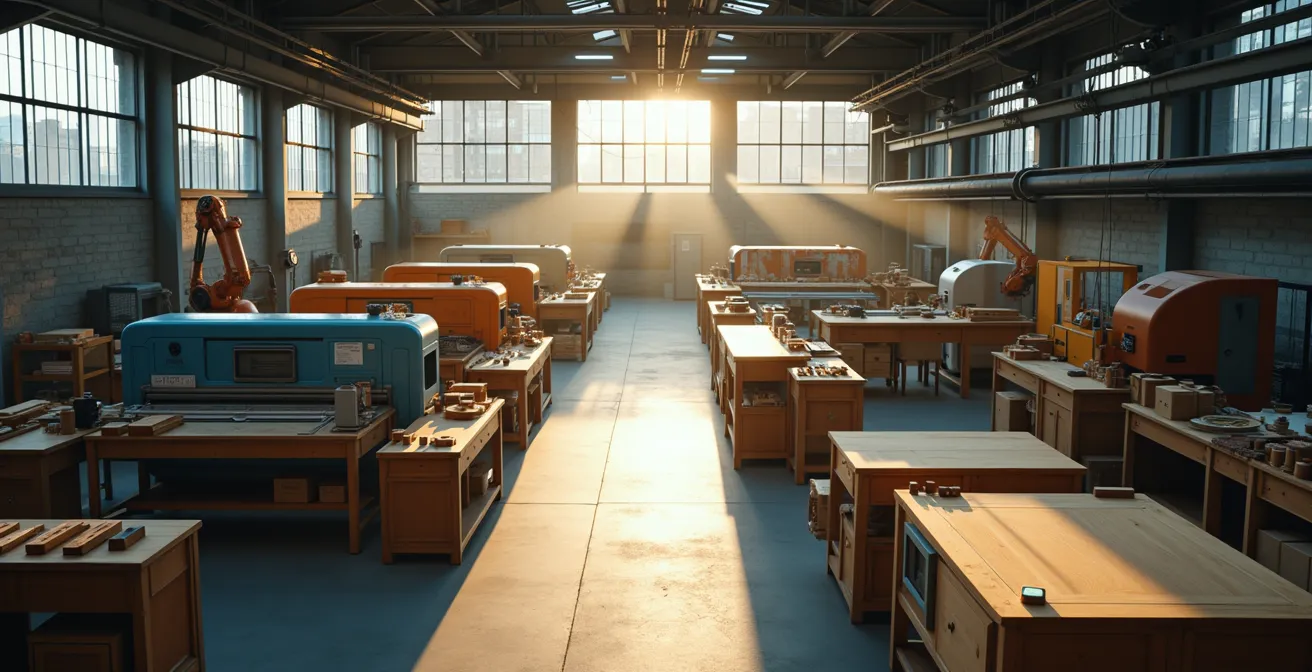
Scaling to an industrial level doesn’t mean sacrificing your craft-based soul, but translating it into a language of data and replicable processes.
- Success lies in quantifying your “secret recipes” into measurable parameters (pH, viscosity).
- Delegation involves a crucial choice: promoting your best artisan (“Guardian of the Temple”) or recruiting a process manager.
- Specific financial tools in Quebec, such as the ESSOR program, are designed to catalyze this transformation.
Recommendation: Start with a 4.0 diagnostic to map your current processes and identify the most impactful “quick win” before any major investment.
You are at the head of a Montreal SME, and the order book is exploding. Every product that leaves your workshop carries your signature, the fruit of a unique know-how, almost an art. But demand now exceeds your artisanal capacity. Nights are getting longer, pressure is rising, and the idea of industrializing becomes inevitable. A legitimate fear then sets in: how to grow without selling your soul? How to mass-produce what was conceived with the heart, without quality—that famous “artisanal DNA”—dissolving into the gears of a production line?
The usual answer is to think in terms of equipment: “let’s buy a bigger machine.” We look at automation, standardization—concepts that seem cold and foreign to the original passion. Yet, this approach misses the point. The challenge is not to replace humans with machines, but to succeed in a cultural and operational transition. It is a true work of translation: how to transform intuition into data, the “knack” into a procedure, and passion into a replicable process of excellence.
This article is not an engineering manual. It is the roadmap of an operations director who has supported dozens of companies like yours. We aren’t just going to talk about machines or software. We are going to dissect the critical tipping points: the transformation of your expertise, the choice of your first leaders, investment decisions in the face of uncertainty, and managing the financial trap that growth sets for you. We will see how to transform your factory, step by step, by leveraging the specific drivers of the Quebec ecosystem.
To guide you through the challenges and opportunities of this major transformation, this article is structured to address each tipping point pragmatically. Here are the key steps we will explore together.
Summary: The game plan for industrializing your Montreal SME
- Why your “grandma’s recipes” no longer work on industrial machines?
- How to choose your first team leaders so you no longer manage everything yourself?
- Flexible or dedicated high-speed machine: which choice for uncertain demand?
- The growth trap that consumes all your cash in inventory and accounts receivable
- Which module to start the implementation with to guarantee a Quick Win?
- Why your current ERP is holding back your transition to Industry 4.0?
- Why the AS9100 standard is a non-negotiable (and costly) prerequisite?
- How to transform your traditional factory into Industry 4.0 with the ESSOR program?
Why your “grandma’s recipes” no longer work on industrial machines?
The heart of your success lies in an exceptional product, a “grandma’s recipe” of which only you, or your most loyal artisan, hold the secret. The problem is that this secret is often intangible, based on intuition, “feeling,” a certain touch. However, an industrial machine does not understand “feeling.” It understands degrees Celsius, pH levels, cycle times, and viscosity in centipoise. The failure of many transitions comes from this: trying to have a machine that only reads mathematics perform poetry.
The first step of industrialization is therefore not to buy equipment, but to embark on a work of operational translation. Your mission is to break down your art into a series of scientific, measurable, and reproducible parameters. The perfect texture of your cream? That’s a precise viscosity curve. The unique taste of your sauce? It’s a combination of Brix, pH, and cooking time at a stabilized temperature. This process is fundamental because it creates an objective quality standard, independent of the operator.
This quantification goes beyond your product. It also affects raw materials. The local supplier you had a relationship of trust with may be replaced by an industrial distributor. Their products, although standardized, may have slightly different characteristics. It then becomes crucial to qualify each new ingredient, no longer by judgment, but with measuring instruments. Finally, this new rigor must integrate regulatory constraints, notably MAPAQ standards on allergens or preservatives, which become non-negotiable at scale.
Your action plan: transforming the artisanal recipe into an industrial standard
- Initial diagnostic: Perform a complete audit of your current production to identify key steps based on intuition and undocumented know-how.
- Sensory quantification: Translate each sensory parameter (taste, texture, smell, color) into measurable and objective data (pH, viscosity, Brix, colorimetry).
- Raw material qualification: Establish precise specifications for your industrial suppliers and systematically test new raw materials before integrating them.
- Regulatory compliance: Adapt your recipes to scrupulously respect MAPAQ regulations, especially regarding allergen management and the use of preservatives.
- Training and buy-in: Involve your teams from the beginning, train them on new processes and new technologies to ensure the transition is a collective success.
How to choose your first team leaders so you no longer manage everything yourself?
As long as the company is small, the leader is the “one-man band.” As highlighted in a case study on SME transformation, revenue is often directly linked to the founder’s productivity capacity. To scale, you must delegate. But to whom? This is where the first big managerial dilemma arises: promoting your best artisan, the “Guardian of the Temple,” or recruiting an external process manager.
It is easy to guess that only the leader carried the ‘success’ of the company. This means that the turnover was closely linked to his own productivity capacities.
– Blacksmitd Industrie Case Study, Transformation of a craft-based company into an industrial SME
The Guardian of the Temple knows the product inside out. They are respected by the team for their technical expertise and embody the company’s DNA. Their promotion seems natural and guarantees quality continuity. The risk? They may struggle to shift from a “doing” logic to a “getting things done” logic. Their expertise may lead to micromanagement, and they will likely lack skills in planning, budget management, or team leadership, which will require a significant investment in training.
The Process Manager, on the other hand, arrives with a manager’s toolbox. They think in terms of efficiency, KPIs, and standardization. They are capable of structuring growth, optimizing flows, and setting up the management rituals of an industrial SME. Their challenge? They know nothing about your product. They will have to earn legitimacy from a team that sees them as an outsider, a “office guy.” The cost of their training will focus on adopting your culture and unique know-how. There is no right or wrong answer, but a strategic choice to make based on your culture and priorities.
This comparative table will help you weigh the pros and cons to make the best decision for your organization.
| Criteria | Guardian of the Temple (Promoted best artisan) | Process Manager (External manager) |
|---|---|---|
| Product knowledge | Excellent – Perfect mastery of recipes and techniques | Low – Requires in-depth training |
| Management skills | Limited – Requires management training | Strong – Proven experience in team management |
| Team buy-in | Natural – Respected for expertise | To be built – Must prove legitimacy |
| Strategic vision | Product-oriented – Risk of micromanagement | Process-oriented – Global vision of efficiency |
| Training cost | High in management and administration | High in product knowledge |
Flexible or dedicated high-speed machine: which choice for uncertain demand?
The question of equipment is central, but often poorly framed. The reflex is to look for the fastest machine to meet growth. Yet, this decision is primarily strategic rather than technical, especially when future demand is uncertain. The danger is locking yourself into a rigid choice without having done the groundwork—a situation that is unfortunately common since, according to a survey, nearly 50% of Quebec manufacturing companies have not performed recent strategic planning.
Here are the two major opposing philosophies:
- The dedicated high-speed machine is the equivalent of a Formula 1 car. It is designed for a single task, which it executes at maximum speed with redoubtable efficiency. It is the ideal choice if you produce very large volumes of a single, standardized product. Its major drawback is its inflexibility. The slightest change in format, recipe, or packaging can lead to costly and complex downtime.
- The flexible production line is like a modular SUV. It is composed of several modules that can be reconfigured quickly. Its top speed is lower, but it excels in managing variety: small batches, multiple products, diversified formats. It is the option of prudence and agility, perfect if your market is volatile or if you plan to expand your product range.

The choice depends on your 3-5 year vision. Do you plan to focus on your flagship product or diversify your offering? Does your main client require a single reference in large quantities or a multitude of variations? The mistake would be to underestimate the cost of inflexibility: every order refused because your dedicated machine cannot produce it is a loss of revenue and an open door for the competition. Before signing the purchase order, calculate this opportunity cost.
The growth trap that consumes all your cash in inventory and accounts receivable
Growth is a powerful engine, but it consumes a lot of fuel: working capital. This is the cruelest paradox for an expanding SME. You sign big contracts, you invest in raw materials, you produce more than ever… and yet, the bank calls you because the account is empty. This phenomenon is explained by the explosion of your Working Capital Requirement (WCR). Your stocks increase to meet demand, and your accounts receivable swell because large prime contractors often pay at 60, 90, or even 120 days.
This pressure on cash flow is one of the main obstacles to growth. A recent report highlights that for Quebec SMEs, the lack of working capital is a major concern, on par with the labor shortage. Indeed, according to the CFIB 2024 Outlook, while 49% of SMEs cite the shortage of skilled labor, nearly 29% mention the lack of liquidity as a direct obstacle to their development.
Fortunately, the Quebec ecosystem has developed specific tools to help manufacturing SMEs overcome this challenge. It is crucial not to wait until you are in the red to explore them. Anticipating financing needs is a key step in strategic planning. These solutions go beyond simple bank loans and are often designed to support transformation projects.
Case Study: Working Capital financing solutions available in Quebec
Quebec SMEs in the growth and industrialization phase are not alone. Government and local programs are specifically designed to support them. The ESSOR program, managed by Investissement Québec, offers loans and loan guarantees for investment projects related to automation and digital transformation. At the local level, Local Investment Funds (FLI), managed by MRCs (Regional County Municipalities), offer financing adapted to regional realities. Finally, initiatives like the Evol program combine financing and personalized support for growing businesses. These tools make it possible to finance not only the machines but also the additional working capital generated by expansion.
Which module to start the implementation with to guarantee a Quick Win?
Industrialization is a marathon, not a sprint. Trying to change everything at once is the best way to demotivate your teams, exceed your budget, and fail. The key to success lies in a progressive approach, focused on obtaining a Quick Win. A quick win is a pilot project, limited in scope, that brings visible and measurable results in a short time. Its goal is less about immediate return on investment and more about creating positive momentum and proving to the entire organization that change is possible and beneficial.
How to identify this first project? It must meet three criteria: be low cost, low risk, and have a high impact in terms of perception. Don’t start with a full ERP implementation or automating your most complex line. Start small. Sometimes, the best Quick Win isn’t even technological: it can be formalizing a key process on paper, such as quality control, even before thinking about buying software.

An excellent candidate for a first project is often the traceability module. Why? Because it meets a double expectation. Internally, it forces rigor in tracking batches and raw materials. Externally, it has become a non-negotiable requirement for many large customers and distributors, not to mention MAPAQ imperatives. Implementing a traceability system on a single production line allows you to test the technology, train employees, and once successful, communicate this success to your customers. It is a victory that reassures everyone and paves the way for more ambitious projects.
The strategy is to create a snowball effect. Each success builds confidence and releases resources for the next step. Measure the gains, communicate them proudly, celebrate with the teams, then move on to the next module. This is how resistance to change is transformed into true mobilization.
Why your current ERP is holding back your transition to Industry 4.0?
In many SMEs, the ERP (Enterprise Resource Planning) system has grown organically. It is often accounting software onto which a billing module was grafted, then an embryo of inventory management. This system, which has served the company well so far, becomes a true dead weight when it comes to Industry 4.0. The problem is that it was not designed to communicate. It is a fortress of data, not an exchange platform. However, Industry 4.0 relies on the fluid flow of information between machines, software, and humans.
The adoption of advanced digital technologies remains a challenge. A STIQ Barometer study on technological integration reveals that only 22% of manufacturing SMEs use customer or supplier management software (CRM/SRM) and barely 10% use product configuration software. These figures show that information systems are often the poor relation of investment. Yet, a modern ERP is the central nervous system of the connected factory. It must be able to dialogue in real-time with sensors on the production line (IoT) or with a Manufacturing Execution System (MES).
Many SME ‘ERPs’ are just accounting systems with basic modules, lacking the APIs and data granularity necessary to connect to IoT sensors or MES.
– Sectoral Analysis, Portrait of Industry 4.0 in Quebec
Your “home-grown” or older generation ERP becomes a hindrance for several reasons. It operates in silos, preventing a 360-degree view of operations. Its data lacks granularity, making detailed performance analysis impossible. Most importantly, it is devoid of APIs (Application Programming Interface)—those software bridges that allow different systems to communicate. Without APIs, connecting a new temperature sensor or advanced planning software becomes a costly and fragile IT project. Investing in a modern ERP, designed for openness, is not an expense; it is the founding investment of your digital transformation.
Why the AS9100 standard is a non-negotiable (and costly) prerequisite?
Not all industries have the same requirements. If you are in the food industry, MAPAQ and CFIA standards are your references. But if your Montreal SME aims to supply cutting-edge sectors like aerospace, you will encounter another type of barrier to entry: quality certifications. The AS9100 standard is the perfect example. It is the international quality management system standard for the aerospace, space, and defense industries.
Obtaining this certification is a long, demanding, and costly process. It imposes absolute rigor in terms of traceability, risk management, process control, and documentation. For an SME used to an artisanal culture, the shock can be brutal. So, why put yourself through such an effort? Because in this ecosystem, AS9100 is not a competitive advantage; it is a non-negotiable prerequisite. Without it, you simply do not exist in the eyes of major prime contractors like Bombardier, CAE, Pratt & Whitney, or Bell Textron, all of which are massively established in Montreal.
The Montreal ecosystem is unique. As highlighted by Aéro Montréal, Quebec’s aerospace cluster, the metropolis is one of the few places in the world where you can source almost all aircraft parts within a 30 km radius. This ecosystem relies on a network of more than 200 SMEs that collaborate with the sector’s giants. To be part of this club, you must speak the same language, and that language is certified quality.
Montreal’s unique aerospace ecosystem
According to AéroMontréal, Montreal is “one of the rare places in the world where almost all aircraft components can be sourced within a 30 km radius”. This exceptional concentration is based on a dense network of 210 specialized SMEs. These companies can only work with major manufacturers and equipment suppliers by demonstrating absolute compliance with the strictest standards, of which AS9100 is the cornerstone.
Even if you aren’t targeting aerospace, this example is a universal lesson: industrialization often involves conforming to the quality standards of your most demanding clients. It is an investment that opens the doors to the most lucrative markets.
Key Takeaways
- Translate, don’t betray: The success of industrialization does not consist in erasing the artisanal DNA, but in translating it into data, processes, and measurable standards.
- Leadership is a choice, not a given: Promoting your best artisan is not always the best solution. The choice between a “Guardian of the Temple” and a “Process Manager” is one of your most strategic decisions.
- Technology follows strategy: The choice of machines and software (ERP) must stem from your long-term market vision, not the other way around. Financial aid, such as the ESSOR program, is there to support this vision.
How to transform your traditional factory into Industry 4.0 with the ESSOR program?
Taking the step toward industrialization and digital transformation can seem like an insurmountable mountain, especially financially. Fortunately, as a Quebec SME, you are not alone. The Government of Quebec, via Investissement Québec, has put in place a powerful lever to support you: the ESSOR program. This program is not a simple subsidy; it is a true strategic partner designed to catalyze investment projects that increase productivity and competitiveness.
The impact of this program is considerable. A recent evaluation showed that in just 11 months, ESSOR granted 589 million dollars in financial aid to 733 companies, generating a total of 2.3 billion dollars in investments in the Quebec economy. These figures demonstrate the clear will to support the modernization of the local industrial park. For you, this means that your project to buy a flexible machine, implement an ERP, or robotize a back-of-line process may be eligible for substantial financial support.
The ESSOR program is structured into several components to meet different needs, from the first stages of reflection to major investments. Whether you need to finance a digital diagnostic to know where to start or obtain a loan for a multi-million dollar investment project, there is likely a suitable component. Knowing these options is the first step to de-risking your transition financially.
The following table summarizes the main financing options offered by the ESSOR program, an essential tool for any manufacturing SME in Montreal considering its 4.0 transformation.
| Component | Type of project | Maximum Aid | Financing Rate |
|---|---|---|---|
| Component 1A | Feasibility studies | $50,000 | Up to 50% of costs |
| Component 1B | Digital diagnostics | $50,000 | Up to 75% of costs |
| Component 1C | Digital transformation plans | $120,000 | Up to 50% of costs |
| Component 2 | Productivity investment projects | Variable | Loans and guarantees |
| Component 3 | Clean technologies | Variable | According to project |
Transforming your craft-based SME into an industrial powerhouse is an ambitious project, but perfectly achievable with the right method and the right partners. The next step is to accurately assess your digital maturity and build a concrete action plan. To do this, conduct a 4.0 diagnostic to identify opportunities and validate your eligibility for aid programs like ESSOR.