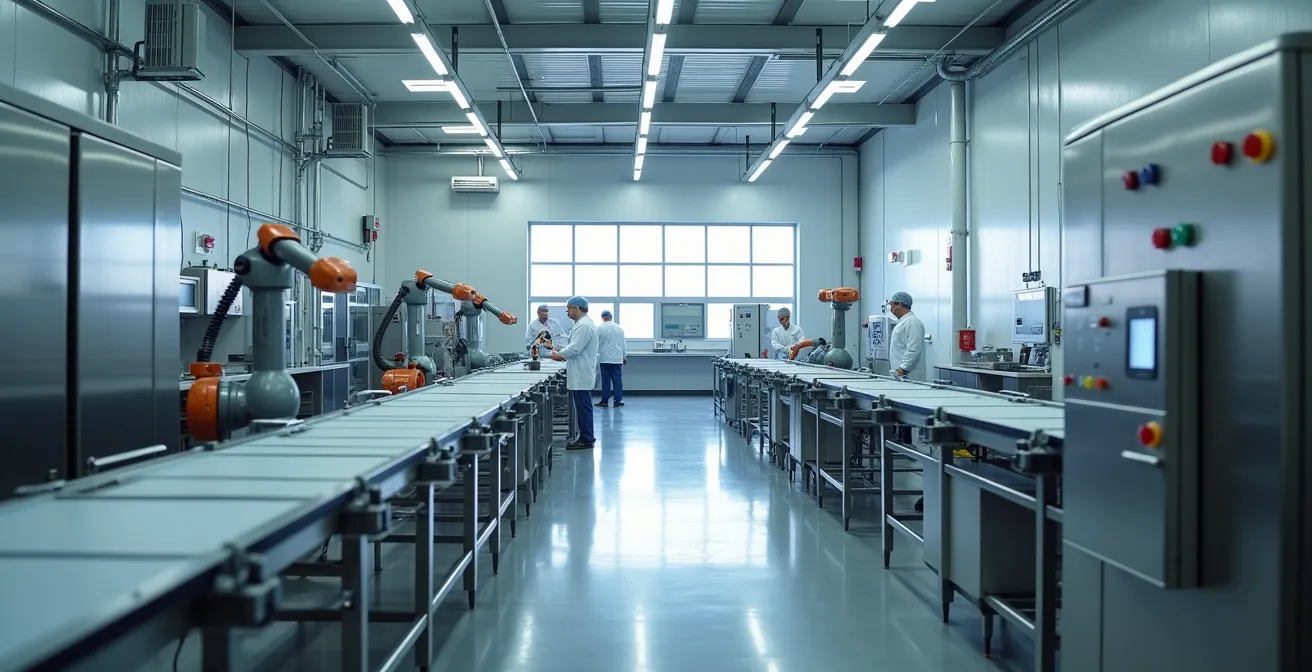
Succeeding in the automation of your food processing plant in Quebec is not just about buying a robot, but about mastering a complex ecosystem of compliance, financing, and human factors.
- Compliance (MAPAQ, HACCP, IP69K) is not an obstacle, but the foundation of a profitable and safe project.
- Managing the human factor and preventing “unconscious sabotage” are more critical for ROI than the technical performance of the machine.
- Financial engineering through programs like Essor is essential to transform a major investment cost into a competitive advantage.
Recommendation: Approach your automation project as a business transformation driven by strategy, rather than a simple purchase of technical equipment.
For any owner of a food processing plant in Montreal and Quebec, the equation is increasingly complex. On one hand, there is a shortage of qualified labor, particularly for critical positions such as butchers or line operators, which threatens production capacity. On the other hand, constant regulatory pressure from the Ministry of Agriculture, Fisheries and Food (MAPAQ) and standards such as HACCP or GFSI demand an irreproachable level of hygiene and traceability. Faced with this double challenge, the temptation is great to see automation as a miracle solution: you buy a robot, you solve the problem.
This vision, while attractive, ignores a crucial reality on the ground. Introducing new technologies into an environment as controlled as food processing is far from a simple technical project. But what if the true key was not in the machine itself, but in mastering the ecosystem surrounding it? Success depends not only on choosing a high-pressure washable robot but on the ability to navigate contamination risks, plan an installation without paralyzing Christmas production, and, above all, manage the human friction that inevitably accompanies change.
This article is not a catalog of robots. It is a strategic guide for managers who must make informed decisions. We will break down, step by step, the points of vigilance and the levers of action to succeed in your transition to Industry 4.0, transforming regulatory and human constraints into true pillars of your future performance. We will see how to not only respect standards but also use them to build a sustainable competitive advantage.
To effectively navigate the multiple facets of this transformation project, this article is structured to address each challenge logically. The following summary will give you a clear overview of the steps we will take together.
Summary: Automating your food processing plant in Quebec: a strategic guide
- Why is automation the only viable response to the shortage of butchers/operators?
- How to select high-pressure washable robots (IP69K) without breaking the bank?
- Flash freezing or modified atmosphere packaging: which choice for export?
- The risk of allergen contamination when introducing new machinery
- When to install your new line so as not to disrupt Christmas production?
- How to set up a closed loop to reuse 80% of your process water?
- Why do your employees unconsciously sabotage new machines?
- How to transform your traditional factory into Industry 4.0 with the Essor program?
Why is automation the only viable response to the shortage of butchers/operators?
The observation is clear and hits the Quebec food processing sector head-on. The difficulty in recruiting and retaining qualified personnel is no longer a simple annoyance, but a structural brake on growth. According to projections, there will be more than 5,600 positions to fill by 2025 in this sector in Quebec. For skilled trades like butchery or specialized operations, where skills transfer is long and the work is demanding, the labor pool is drying up dangerously. This situation creates a critical dependence on a few key employees and drastically limits a company’s ability to respond to demand peaks or develop new markets.
Automation does not intervene here as a simple productivity tool, but as a business sustainability strategy. It helps compensate for the lack of hands for repetitive, physically demanding tasks or those taking place in difficult environments (cold, humidity). The goal is not to replace the human, but to transform their role. Low-value-added tasks are delegated to machines, freeing up employees for supervision, quality control, maintenance, or process optimization roles—positions that are often more stimulating and less taxing.
Case Study: Patates Dolbec and AI Reallocation
Faced with the difficulty of recruiting for manual potato sorting, Patates Dolbec, a Quebec leader, chose to collaborate with Noovelia and Vooban to implement a quality control system using artificial intelligence. Rather than eliminating positions, this automation allowed employees to be reassigned to higher-value-added tasks. The result is twofold: an increase in productivity and quality consistency, coupled with a valuation of the teams’ work, who now focus on more complex missions.
By securing critical operations through reliable robotic systems, a company can guarantee constant production, regardless of labor market fluctuations. This strengthens its resilience and its ability to honor contracts, an essential trust factor for its clients. Automation thus becomes a strategic response to ensure the continuity and development of activities in a context of long-term talent shortages.
How to select high-pressure washable robots (IP69K) without breaking the bank?
Integrating robotics into a food processing environment faces a major constraint: hygiene. MAPAQ directives and HACCP or GFSI certifications impose strict cleaning protocols, often involving high-pressure and high-temperature washing with aggressive detergents. A standard robot not designed for this environment would be quickly damaged, creating contamination risks and exorbitant maintenance costs. The solution lies in IP69K certified equipment, a standard that guarantees total protection against dust penetration and resistance to high-pressure, high-temperature water jets. This certification is non-negotiable for ensuring compliance.
However, “IP69K” often rhymes with “high costs.” The challenge is therefore not to buy everything in an IP69K version, but to adopt a surgical approach. You must precisely analyze your production line to identify the “food zones” (direct or indirect contact with food). Only robots and components operating in these critical zones imperatively require this certification. For end-of-line tasks, such as palletizing already sealed boxes, equipment with a lower protection rating (like IP65 or IP67) may be sufficient and much more affordable. The secret to not breaking the bank is therefore a precise risk analysis upfront.
The acquisition cost must also be put into perspective with the return on investment (ROI). A robot may seem expensive, but it replaces hours of manual labor in difficult conditions, reduces the risk of errors and contamination, and ensures a stable production rate 24/7. The following table, based on market data, gives an order of magnitude of the investments required for different end-of-line applications, a common starting point for automation.
The cost of a robot must be weighed against its ROI. According to the BDC, the average annual cost of a worker in the Canadian food industry can exceed $50,000. A comparative analysis, such as the one proposed by the BDC on robotics in the sector, helps contextualize the initial investment.
| Type of Equipment | 2024 Acquisition Cost | Application | Estimated ROI |
|---|---|---|---|
| Robotic case erector | $120,000 – $200,000 | Automatic box forming | 2-3 years |
| Complete packing system | $200,000 – $400,000 | Primary/secondary packaging | 3-4 years |
| Robotic palletizer | $150,000 – $350,000 | Automatic palletizing | 1-3 years |
Flash freezing or modified atmosphere packaging: which choice for export?
When automation significantly increases production volumes, the question of accessing new markets, especially exports, becomes central. For this, extending product shelf life is a key issue. Two main technologies compete: flash freezing (individual or tunnel) and modified atmosphere packaging (MAP). The choice between the two depends on the nature of the product, the target market, and the desired quality perception.
Flash freezing is a proven method that offers the longest shelf life, facilitating logistics over long distances. It allows the quality of the product to be “frozen” at a specific moment and smooths production throughout the year, decoupling sales from seasonal raw material peaks. It is a robust solution, particularly suited for raw or semi-processed products (meats, vegetables, ready meals). Its main disadvantage can be consumer perception, which sometimes associates frozen food with lower quality than fresh.
Modified Atmosphere Packaging (MAP), on the other hand, consists of replacing the air in the packaging with a specific gas mixture (often nitrogen and carbon dioxide) to slow down bacterial proliferation and oxidation reactions. This technique preserves the “fresh” look of the product, a major marketing asset for meats, prepared salads, or bakery products. Shelf life is extended by several days or even weeks, but remains shorter than flash freezing. MAP is therefore ideal for closer export markets (e.g., the United States) where the cold chain can be perfectly mastered. The choice of one or the other of these technologies must therefore be the result of a complete strategic analysis.
Case Study: Lufa Farms and Production Multiplication
To support their growth, Lufa Farms invested in a new central kitchen in Montreal, partly thanks to financial aid from the Quebec government. The project aimed to automate production while maintaining organic certification. By integrating certified automation and flash freezing equipment, the company succeeded in multiplying its production by 15, going from 350 to 5,200 kg per day. This example demonstrates that a targeted technological investment, aligned with MAPAQ standards, can decuple production capacity and open the door to new opportunities.
The risk of allergen contamination when introducing new machinery
Automation, if poorly managed, can turn a productivity gain into a sanitary nightmare. One of the most critical risks, often underestimated during the design phase, is allergen cross-contamination. Introducing a new robot or a new conveyor on a line that treats both products containing allergens (nuts, soy, gluten, etc.) and products that do not, creates new contact points and potential retention zones. Inadequate management can lead to costly product recalls, damage to brand reputation, and, above all, serious health risks for consumers.
Prevention of this risk relies on two pillars: the hygienic design of the equipment and the validation of cleaning procedures. When selecting machines, you must go beyond IP69K certification and examine design details. Are there hard-to-clean areas, corners, screws, or rough welds where product residues could accumulate? Surfaces must be smooth, non-porous, and self-draining. The detachability of parts in contact with food for deep cleaning is an essential criterion.
The second pillar is the rigorous validation of cleaning protocols. It is not enough to “wash” the machine; you must prove it is free of allergen residues. This involves validation tests (for example, ATP tests or allergen detection kits by swabbing) after cleaning. Furthermore, production planning (sequencing) becomes even more critical: you must always produce non-allergen batches before those containing them. The integration of automation must therefore be accompanied by a complete review and reinforcement of your allergen management plan, in full compliance with MAPAQ and CFIA expectations.
When to install your new line so as not to disrupt Christmas production?
In the Quebec food industry, which represents a dynamic ecosystem of more than 73,000 jobs in nearly 3,100 establishments, seasonality is a determining factor. Choosing the right time to install a new automation line is as crucial as choosing the technology itself. Poor planning can lead to production shutdowns during periods of high demand, causing revenue losses and jeopardizing customer relations. The holiday season is the peak for many processors, and any disruption in November or December is simply unthinkable.
The key is to identify the ideal windows of opportunity, which are the low production periods. For most industries, the beginning of the year represents a golden opportunity.
- January-February: This is the post-holiday period, often the quietest of the year. It’s the perfect time for major installations. Teams are available for training, and tests can be conducted without excessive pressure.
- March-April: A period to watch. For industries related to maple syrup, this is a peak of activity. For others, it can remain a good window.
- May-June: Possible, but the season for berries and summer products begins. Tight planning is needed to avoid interference.
- July-August: This is the production peak for many fresh fruits and vegetables. To be avoided for companies in this sector. This is a maintenance period, not an installation period.
- September-October: The race to prepare year-end orders (Thanksgiving, Christmas) begins. This is a critical period where production must be maximized. Any installation is risky.
The installation project should be planned at least 12 to 18 months in advance, taking into account equipment delivery times, which can be long. A “ramp-up” phase should be planned where the old and new lines might coexist temporarily if space allows. This creates a safety net to guarantee production continuity during the trial phase of the new installation. Communication with sales teams is also essential to manage customer expectations and adjust order forecasts.
How to set up a closed loop to reuse 80% of your process water?
Automation is not just a response to the labor shortage; it is also a major lever for resource optimization and sustainability, aspects increasingly valued by consumers and authorities. Water consumption in food processing plants is considerable, notably for product washing, hydraulic transport, and cleaning cycles (CIP/NEP). Setting up a closed-loop water recycling system is an Industry 4.0 approach that offers a double benefit: a drastic reduction in operating costs (water bill and effluent treatment) and a strong ecological argument. While only 32% of Quebec food processing companies have automated more than half of their systems, optimizing resources like water represents a significant competitive advantage.
The principle of a closed loop is to collect process water (for example, vegetable wash water), treat it on-site to remove contaminants, and then reinject it into the process for non-critical uses where potable water is not required (e.g., pre-washing, transport). Treatment can involve several steps: mechanical filtration for large particles, membrane filtration (ultrafiltration, reverse osmosis) for dissolved contaminants, and disinfection (UV, ozonation) to guarantee microbiological safety.
Installing such a system is a complex engineering project that requires an in-depth analysis of the factory’s water flows, the water quality required at each stage, and strict compliance with MAPAQ standards on water reuse. However, automating the treatment systems themselves (with continuous sensors for turbidity, pH, etc.) guarantees the reliability and safety of the process with minimal human intervention.

As this diagram shows, setting up a circular flow allows for the valuation of a precious resource. This approach fits perfectly into the vision of a smarter and more responsible factory. As André Michaud, President of Agro Québec, points out, this process optimization also has a direct human impact.
Automating background tasks leaves the possibility and time for workers to focus on value-added tasks.
– André Michaud, President at Agro Québec
Why do your employees unconsciously sabotage new machines?
One of the most frequent and costly obstacles to an automation project is not technical, but human. You can install the most powerful robot on the market, but if your employees see it as a threat or a burden, its ROI will be compromised. This “sabotage” is rarely malicious or conscious. Rather, it is human friction, a natural resistance to change that manifests through micro-behaviors: bypassing a procedure, ignoring an alarm, “forgetting” a maintenance step, or simply using the machine inefficiently due to a lack of understanding or fear. These actions, accumulated, lead to breakdowns, quality drops, and chronic underperformance of the equipment.
The roots of this friction are manifold: the fear of losing one’s job, the fear of not being up to the task when faced with complex technology, the loss of expert status on the old system, or simply nostalgia for old work habits. The trend toward automation is inevitable, as the pandemic showed. Les Tomlin, President of PizzaForno, saw his sales jump by 400% thanks to vending machines, as customers wanted to limit contact. This external pressure for automation must be accompanied by an internal strategy for acceptance.
The pandemic accelerated the trend exponentially. As early as April, I noticed that people wanted to eat high-quality pizza but also wanted to limit their contact.
– Les Tomlin, President of PizzaForno
Defusing this human friction requires a proactive change management strategy, well before the machines arrive. The secret is to transform employees from “victims” of change into “actors” of transformation. This involves transparent communication, early involvement, and adapted training. The following list of actions constitutes a roadmap for ensuring the buy-in of your teams.
Action Plan for Team Buy-in: Your Checklist
- Involve the health and safety committee from the project design phase to reassure them on safety aspects.
- Identify key employees to become “power users” and send them for training directly at the equipment supplier’s site.
- Use the training components of government aid programs (such as the Food Transformation Program) to finance skill development.
- Co-create new workstations and new procedures with union representatives and operators to guarantee their relevance and ergonomics.
- Personalize human-machine interfaces (HMI) with future operators to make them more intuitive and user-friendly.
- Establish a transparent communication plan about the project’s benefits for the company AND for the employees (less physical strain, new skills, etc.).
Key Takeaways
- Regulatory compliance (MAPAQ, IP69K, allergens) is not a constraint, but a framework that, when mastered, guarantees the security and value of your investment.
- The success of automation ROI depends less on the machine’s technical performance than on team buy-in. Change management is the key.
- Government aid programs like Essor are not simple subsidies, but strategic tools that, when used properly, transform an automation project into a powerful lever for competitiveness.
How to transform your traditional factory into Industry 4.0 with the Essor program?
Automating and digitizing a food processing plant represents a significant investment. Fortunately, the Quebec government, aware of the sector’s strategic stakes, has put in place powerful financial levers to support companies in this transition. The Essor program, managed by Investissement Québec, is one of the most important tools for co-financing projects aimed at increasing competitiveness and productivity. Added to this is the Food Transformation Program from MAPAQ, which has massively supported the sector, with more than $100 million granted between 2021 and 2023 for 849 projects, generating total investments of $850 million.
Obtaining this aid is not a simple formality. It involves presenting a solid file that demonstrates not only the technical viability of the project but, above all, its economic profitability and its alignment with government priorities (increased productivity, reduction of labor shortages, sustainable development, etc.). The approach should not be “how to get a grant for my robot?” but rather “how to build a 4.0 transformation project that is eligible for the best financing programs?”
To maximize your chances of success, rigorous preparation is indispensable. It is not enough to have a quote from an equipment manufacturer. You must build a complete business plan. Here are the key steps to building a winning file:
- Perform a digital diagnostic: Use a recognized organization like the Centre de recherche industrielle du Québec (CRIQ) to assess your digital maturity and identify the most promising automation projects. This diagnostic is often a prerequisite.
- Assemble a detailed business plan: Your plan must include market analysis, a technical description of the project, and above all, clear financial forecasts with a demonstrated ROI over 3 to 5 years.
- Identify ministerial priorities: Certain projects (robotization, increasing food autonomy, etc.) may benefit from bonuses. Align your project with these priorities to increase the aid rate.
- Combine programs: Don’t limit yourself to a single program. Explore combining provincial aid (Essor), federal aid (e.g., PCAN), and investment and innovation tax credits.
- Call upon a specialist: Preparing grant applications is a specialized field. Collaborating with a specialized consultant can greatly increase your chances and optimize the amounts obtained.
To turn these strategies into a concrete action plan for your plant, the next step consists of conducting a 4.0 diagnostic and assembling a solid financing file. Evaluate now the solution most suited to your specific needs to ensure the sustainability and growth of your business in the Quebec food landscape of tomorrow.