Summary:
- Compliance is not optional: fines for non-compliance with discharge standards in Montreal can reach $500,000.
- The key is proactive monitoring: a simple pH fluctuation or grease discharge can lead to significant repair costs and surcharges.
- Effluent treatment is a profitable investment: systems like closed loops can reduce water consumption by up to 80% and protect you from new volumetric pricing.
- Sampling representativeness is crucial: non-compliant samples trigger costly inspections and reporting obligations.
Receiving a notice of non-compliance from the City of Montreal’s Environment Department is a major concern for any plant manager. The pressure to maintain smooth production while managing regulatory complexities can be overwhelming. Many believe that compliance is simply about checking boxes and meeting concentration limits on a report. Focus is often placed on obvious parameters, such as heavy metals in a plating plant or biochemical oxygen demand (BOD) in the food industry. One invests in a treatment system and hopes for the best.
But what if the true key was not just to treat, but to prevent? And what if compliance was not a cost center, but an operational management discipline? The angle many miss is that the most expensive fines don’t always come from chronic pollution, but often from a one-off, unforeseen event: a pH probe drifting for an hour, a production peak saturating the system, or a grease accumulation that seemed harmless. Montreal’s oversight is tightening, and with the arrival of volumetric pricing, ignoring water management is no longer an option.
This article adopts the perspective of a field engineer. We are not going to simply list the standards. We will dissect the failure points that cost money and the pragmatic strategies to transform this regulatory constraint into an advantage. We will see why a simple pH measurement is so critical, how a closed-loop system becomes a lever for profitability, and how to choose the right treatment technology for your specific effluents. The goal is to give you the tools to anticipate problems, dialogue effectively with inspectors, and secure your operations over the long term.
To navigate effectively through the City’s complex requirements, this article is structured to address each point of vigilance strategically. Discover below the essential aspects we will cover to help you master your compliance.
Summary: Mastering Wastewater Compliance in Montreal
- Why a pH fluctuation of a few minutes can trigger a heavy fine?
- How to implement a closed-loop system to reuse 80% of your process water?
- Physico-chemical or biological treatment: which solution for your specific effluents?
- The mistake of discharging grease that solidifies in municipal sewers (and the cleaning bill)
- When to perform your water sampling to be representative in the eyes of inspectors?
- How to select high-pressure washable robots (IP69K) without breaking the bank?
- When to start updating to new ISO standards to avoid losing your certificate?
- Why contesting a CNESST decision can save your future contributions?
Why a pH fluctuation of a few minutes can trigger a heavy fine?
In industrial effluent management, pH is often perceived as a routine parameter. However, its fluctuation is one of the most frequent and costly causes of non-compliance in Montreal. The municipal by-law is strict: the pH of water discharged into the sewers must be between 6.0 and 9.5. Any deviation, even for a short duration, constitutes an offense. The financial consequences are far from negligible. Indeed, according to the CMM 2008-47 by-law on discharges to sewers, fines for non-compliance can range from $1,000 to $500,000.
But why such severity? The reason is simple: municipal sewers are critical concrete infrastructure. A pH that is too acidic (below 6.0) or too basic (above 9.5) chemically attacks and corrodes these pipes, threatening their structural integrity over kilometers. Furthermore, extreme pH can severely disrupt the biological processes of the Jean-R.-Marcotte wastewater treatment plant, which treats water for the entire island. The City is therefore protecting its asset and its treatment capacity.
The most common point of failure in a plant is often the pH probe itself, or the neutralizing injection system (acid or caustic soda). A poorly calibrated, fouled, or defective probe can provide an erroneous reading, leading to incorrect adjustment and non-compliant discharge. A production peak can also generate a volume of effluent that the treatment system cannot neutralize quickly enough. For an inspector, a spot sample showing a pH of 5.5 or 10.2 is sufficient proof to issue a statement of offense, regardless of whether the situation lasted only a few minutes.
How to implement a closed-loop system to reuse 80% of your process water?
In the face of Montreal’s new volumetric water pricing, which heavily penalizes large consumers, water reuse is no longer a simple ecological initiative, but a powerful lever for profitability. Implementing a closed-loop treatment system, capable of recycling up to 80% of your process water, transforms an unavoidable cost center into a strategic investment. The idea is to treat your effluents to a quality level sufficient for reinjection upstream in your process (for example, for rinsing stages), thus drastically reducing your potable water consumption and discharge volume.
The economic argument is implacable, as demonstrated by the City’s pricing schedule. An industrialist consuming 150,000 m³ per year would see their water bill reach $90,000, not including potential surcharges on the pollutant load. Reducing this consumption by 80% generates direct and substantial savings.
The table below clearly illustrates the financial impact of water consumption for non-residential establishments in Montreal, a determining factor in the decision to invest in recycling technologies. Data comes directly from the City of Montreal and shows how the bill can quickly climb.
| Annual Consumption | Tariff per m³ | Typical Financial Impact |
|---|---|---|
| Less than 1,000 m³ | Exempt | $0 |
| 1,000 to 9,999 m³ | $0.10 | $100 to $999 |
| 10,000 to 99,999 m³ | $0.20 | $2,000 to $19,999 |
| More than 100,000 m³ | $0.60 | $60,000 and more |
The technology behind these systems often relies on a combination of advanced filtration (ultrafiltration, reverse osmosis) and disinfection (UV, ozonation). The choice depends on the nature of your contaminants and the water quality required for your process. The case of a Montreal restaurant detected for a continuous consumption of one liter per second, although linked to a leak, demonstrates that the City actively monitors volumes and will not hesitate to bill accordingly. For large-scale projects, financial aid may exist. For example, Investissement Québec’s ESSOR program has already offered grants for the adoption of clean technologies in certain sectors.

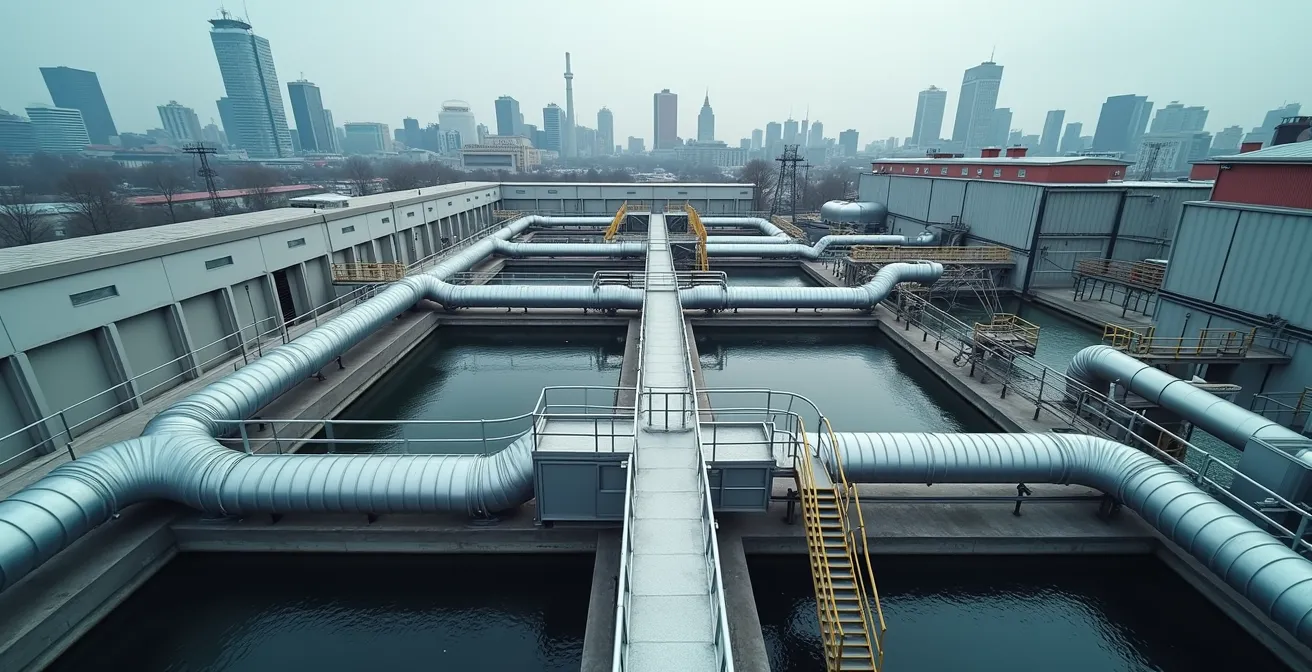
Installing such a system, like the one visualized above, requires precise engineering to ensure that recycled water does not contaminate the final product. However, the amortization of the investment is often rapid, not only through water savings but also through the reduction of discharge fees and protection against future rate hikes.
Physico-chemical or biological treatment: which solution for your specific effluents?
Choosing the right wastewater pre-treatment system is a critical decision that depends entirely on the nature of your contaminants. There is no one-size-fits-all solution, and a selection error can lead to high operating costs and poor compliance. The City of Montreal is clear on this subject: its infrastructure is not designed to handle everything. As the Environment Department points out, the treatment plant process is not adapted to eliminate all industry-specific contaminants.
The Treatment Plant’s process is not specifically adapted to the reduction of all contaminants; several industries must treat their metal-laden industrial wastewater before discharging it.
– City of Montreal, Environment Department – Quality of water bodies
Fundamentally, the choice comes down to two main families of processes: physico-chemical and biological.
Physico-chemical treatment is the method of choice for effluents containing inorganic pollutants. This is the case for plating, surface treatment, or chemical industries, whose discharges are laden with heavy metals (copper, zinc, nickel), cyanides, or oils and greases. The principle consists of adding chemical reagents (coagulants, flocculants) to destabilize pollutants, cause them to agglomerate into heavier flocs, and then separate them from the water by decantation or flotation. It is a robust, fast, and very effective process for meeting discharge limits on metals, but it generates chemical sludge that must be managed and disposed of by a specialized firm.
Biological treatment, conversely, is ideal for effluents rich in biodegradable organic matter. This is the domain of food industries (dairies, slaughterhouses, breweries), pharmaceuticals, or paper mills. This process uses microorganisms (bacteria) that “consume” organic pollution, measured by BOD (Biochemical Oxygen Demand) and COD (Chemical Oxygen Demand). These can be activated sludge systems, trickling filters, or membrane bioreactors (MBR). It is a “greener” solution, but it requires finer control of conditions (temperature, oxygen, pH) and is sensitive to toxic shocks (an accidental spill of cleaning product can “kill” the biomass and stop the treatment).
The mistake of discharging grease that solidifies in municipal sewers (and the cleaning bill)
Among the contaminants most underestimated by industries, particularly in the food and large-scale catering sectors, are oils and fats. The problem seems trivial: hot and liquid when discharged, they cool and solidify against the cold walls of the sewers. Over time, they agglomerate with other debris to form massive grease plugs hard as rock, known as “fatbergs.” These obstructions reduce pipe capacity, cause backups, and may require complex and costly cleaning operations (high-pressure hydro-jetting) which are, unsurprisingly, billed back to the responsible company.
The City of Montreal takes this problem very seriously, as it knows that a small fraction of companies is responsible for a large part of the network’s load. The data is telling: according to City of Montreal data on industrial consumption, about 12% of non-residential establishments are responsible for 75% of total water consumption. The same logic applies to the pollutant load, and grease is an indicator that is easy for inspectors to trace.

The preventive solution is well known to engineers: the installation of a correctly sized and maintained grease interceptor (or grease trap). For larger flows, a dissolved air flotation (DAF) system, like the one illustrated above, is often required. This process injects microbubbles of air into the effluent, which attach to grease particles and float them to the surface, where they are scraped and collected. It is an investment, but it must be compared to the potential cost of an emergency city intervention, a fine for non-compliance, and production shutdowns associated with a sewer backup in your own plant.
Maintenance is key. A grease interceptor that is not regularly emptied becomes a source of pollution itself, releasing fatty acids and high BOD. Maintenance discipline is therefore as important as the equipment itself.
When to perform your water sampling to be representative in the eyes of inspectors?
The question of sampling is at the heart of the relationship between an industry and the regulatory authority. The objective is not to find the “perfect window” to cheat, but to ensure that the analyzed samples are truly representative of your normal operations. A sample taken during a production shutdown or a period of low activity will not be judged credible by an inspector and may even arouse suspicion. Conversely, a spot sample taken during an exceptional peak could put you in a non-compliant situation even though your daily average is perfectly acceptable.
The best practice, and the one preferred by the City, is 24-hour composite sampling. An automatic sampler takes small quantities of effluent at regular intervals (for example, every 15 minutes) in a single refrigerated container. The analysis of this composite sample gives a faithful image of the average load discharged over a full day, smoothing out the peaks and troughs. It is the fairest and most defensible method.
Monitoring reports are also a key element of oversight. The submission frequency in Montreal depends on your flow. For flows below 10,000 m³/year, an annual report is sufficient. Between 10,000 and 50,000 m³/year, it becomes biannual. And for any new setup, a complete initial characterization is required within six months. These reports must be rigorous and document not only the results but also the sampling methodology. In the event of an accidental spill, responsiveness and transparency are paramount, as stipulated in the official procedure.
Action plan in case of an accidental spill in Montreal
- Immediate declaration: Contact the City of Montreal without delay to report the incident, its nature, and its estimated magnitude.
- Cause report: Submit a detailed report explaining the causes of the spill within 15 days.
- Documentation of corrective measures: Provide proof of immediate corrective measures implemented to contain and clean up the spill.
- Prevention plan: Submit a concrete action plan explaining how you will modify your processes or equipment to avoid any recurrence of the incident.
Sampling management is a discipline. It requires reliable equipment, clear procedures, and flawless documentation. It is your best defense and proof of your due diligence in case of an inspection.
How to select high-pressure washable robots (IP69K) without breaking the bank?
Effluent management does not start at the drain outlet, but at the heart of the production process. In industries like food processing, where hygiene is paramount, cleaning operations are a major source of wastewater laden with organic matter and chemicals. The use of unsuitable equipment, which requires long and aggressive cleaning, directly contributes to increasing the pollutant load of your discharges. This is where the choice of production equipment, such as robots, becomes an integral part of your water management strategy.
An IP69K certified robot is designed to withstand high-pressure washdowns (up to 100 bars) and high temperatures (up to 80°C). This capability allows for faster, more efficient cleaning and, paradoxically, often with fewer aggressive chemicals. A non-certified robot, with nooks and retention areas, requires more time and products to reach the same level of cleanliness, resulting in a larger and more concentrated effluent.
The challenge is the initial cost, often higher for IP69K models. To avoid breaking the bank, the strategy consists of analyzing the total cost of ownership (TCO) rather than just the purchase price. Calculate the savings generated by the reduction in cleaning time (productivity gain), the decrease in water and chemical consumption, and the reduction in effluent treatment costs. Often, the return on investment is faster than you might think. Furthermore, it is not always necessary for all robots on a line to be IP69K. A risk analysis can identify the most critical areas (direct product contact, spray zones) where this investment is justified, and opt for less expensive models (IP67) in less exposed areas.
When to start updating to new ISO standards to avoid losing your certificate?
Compliance with Montreal’s discharge standards does not exist in a vacuum. For many companies, it is part of a much broader framework: the environmental management system, often ISO 14001 certified. This international standard is periodically updated to reflect best practices and new expectations regarding environmental performance. Ignoring these updates means risking the loss of a certification that is often a prerequisite for accessing certain markets or responding to tenders from large prime contractors.
The question is therefore not *if* you should adapt, but *when* to start the process. The answer is: as soon as the draft standard (DIS – Draft International Standard) is published. ISO standard revisions follow a long and predictable process. Waiting for the final publication to start acting is setting yourself up for a race against time. The transition period granted to comply (generally three years) may seem long, but it goes by very quickly.
The update process should start with a gap analysis: compare the requirements of the new version with your current system. New versions often emphasize life cycle analysis, risk and opportunity management, and the integration of environmental performance into the company’s overall strategy. Regarding water, this could mean new requirements for measuring your water footprint, seeking alternatives to reduce consumption, or a more in-depth analysis of risks related to your discharges. Starting early gives you time to plan necessary investments (like a closed loop, seen previously), train your teams, and implement new monitoring procedures without disrupting your operations.
To remember
- Compliance in Montreal is a matter of risk management: a small pH drift or a grease discharge has direct and significant financial consequences.
- The new volumetric water pricing transforms investments in recycling technologies (closed loop) into powerful levers for profitability.
- The choice of treatment system (physico-chemical vs. biological) must be dictated by the nature of your contaminants to be effective and cost-efficient.
Beyond effluents: why rigor always pays off
Rigorous effluent management, as we have seen, is an essential discipline for the sustainability and profitability of a plant in Montreal. However, this rigor should not stop at the drainage drain. It must infuse the entire risk management culture of the company. A striking example, which may seem disconnected but falls under the same logic, is the management of CNESST files. Contesting a decision from the Commission des normes, de l’équité, de la santé et de la sécurité du travail may seem like an administrative burden, but it can have a direct and significant impact on your future contributions.
When a workplace accident is attributed to your company, it affects your file and can lead to an increase in your contribution rate for years to come. If you believe the decision is unjustified, that the accident is due to a personal condition of the worker not related to work, or that the duration of compensation is excessive, contesting the decision with a well-documented file is a move of financial diligence. It is the same logic as contesting a water surcharge based on a non-representative sample.
This brings us back to our central point: operational excellence relies on a discipline of measurement, documentation, and proactive risk management. Whether it’s proving that your pH remained within the limits, demonstrating the effectiveness of your grease interceptor, or contesting a CNESST claim, the principle is the same: reliable data and rigorous documentation are your best assets. Adopting this mindset in all aspects of management – from environment to health and safety – not only protects your finances but also strengthens the resilience and reputation of your company.
To transform regulatory compliance into a true competitive advantage, the next step is to conduct a complete audit of your current processes and management systems. Evaluate now the most suitable solutions for your specific needs to guarantee your peace of mind and optimize your operational costs.
Frequently Asked Questions about CMM 2008-47 Discharge Standards
When is a characterization of wastewater mandatory?
Characterization is required if you discharge more than 10,000 m³/year of wastewater or if you discharge contaminants listed in the CMM 2008-47 by-law.
Who must supervise the characterization report?
The report must be supervised by a competent person who is a member of the Ordre des ingénieurs du Québec, the Ordre des chimistes, or professional technologists.
Can process water be discharged into the storm sewer?
Only if it meets the standards of Article 6 and has prior authorization from the MELCC (Ministère de l’Environnement, de la Lutte contre les changements climatiques, de la Faune et des Parcs) and the municipality.