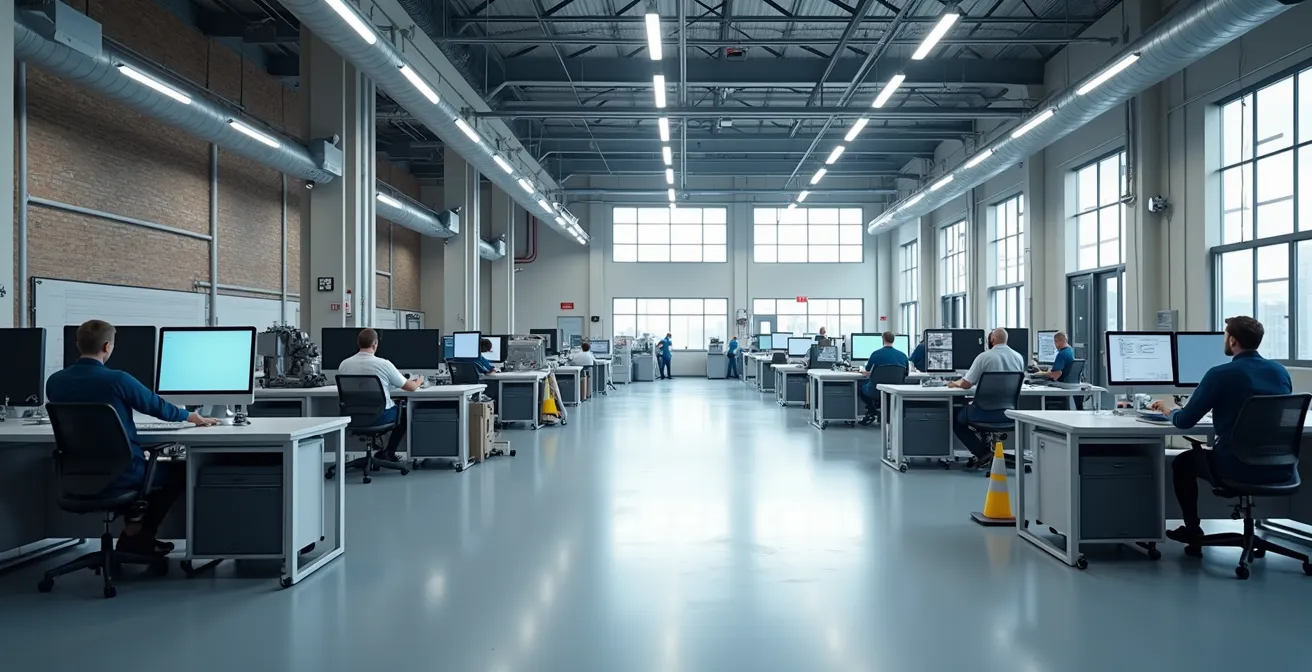
MSD prevention is not just about purchasing equipment, but about implementing a measurement and predictive analysis ecosystem to neutralize risks before an injury occurs.
- Classic strategies like task rotation are ineffective without precise mapping of biomechanical constraints.
- Objective data, sourced from AI or “delta-pain” surveys, allows for targeted investments and documents your due diligence with the CNESST.
Recommendation: Initiate a pilot project on a critical workstation to quantify risks, implement a measurable solution, and calculate the return on investment regarding future premiums.
As a Human Resources manager in Montreal, you are likely observing a concerning trend: an increase in back pain, tendonitis, and other musculoskeletal disorders (MSDs) within your teams. Every new CNESST claim is not only a human tragedy but also a growing administrative and financial burden for your company. In the face of this, standard responses—such as “proper posture” training or buying a new chair—often seem like mere bandages on a hemorrhage. These actions, while useful, treat symptoms without addressing the root of the problem.
Risk factors for MSDs are manifold: repetitive movements, excessive force, awkward postures, but also more insidious elements like vibrations or inadequate lighting. The real challenge is no longer reacting to a declared injury, but building a proactive and measurable prevention strategy. What if the key wasn’t guessing where the next risk lies, but quantifying it? What if, instead of suffering the costs, you could anticipate and neutralize them upstream?
This article proposes a certified ergonomist’s approach, rooted in the reality of Quebec businesses. We will move away from a logic of reaction to embrace a culture of prediction. Through concrete strategies, we will see how to transform your prevention obligations into a genuine performance lever, using objective data to justify every action, optimize your equipment, and solidify your files before the CNESST.
This article is structured to provide you with a clear roadmap, ranging from deconstructing myths to implementing concrete measurement tools, to the strategic management of your CNESST files. Discover how every prevention action can and must be a documented and profitable investment.
Summary: Your Roadmap for Ergonomic Risk Prevention
- Why is task rotation ineffective if all stations stress the same shoulder?
- How AI analyzes your surveillance videos to detect poor postures
- Lift table or vacuum lifter: which equipment for your 20 kg boxes?
- The risk of inadequate lighting on the quality and health of inspectors
- When to survey employees on their pain: before or after the shift?
- How to integrate cobots on a manual assembly line without frightening employees?
- How to position extraction arms to capture 95% of welding fumes?
- Why contesting a CNESST decision can save your future premiums?
Why is task rotation ineffective if all stations stress the same shoulder?
Task rotation is one of the most common recommendations for preventing MSDs. The idea seems logical: by changing stations, movements are varied, and overstressing a single muscle group is avoided. However, on the ground, this strategy fails miserably if it is not based on rigorous analysis. If an employee moves from a station where they lift their right arm to another where they push boxes with their right shoulder, the rotation only changes the nature of the constraint without ever letting the joint rest. The risk of MSDs, far from decreasing, may even worsen.
The stakes are high when you consider that, according to data compiled by the IRSST, musculoskeletal disorders represent about 30% of claims accepted annually by the CNESST, leading to prolonged absences. A poorly designed rotation is therefore a missed opportunity for prevention and a maintained financial risk. The key is not to rotate people, but to rotate the muscle groups involved. This requires moving from intuition to true constraint mapping.
This approach, known as quantified ergonomics, involves breaking down each task to precisely identify which parts of the body are being strained: shoulders, back, wrists, knees. By creating a visual constraint matrix for each station, you can then plan a rotation that intelligently alternates a station demanding for the shoulders with another that relies more on legs or manual dexterity. This is the only way to guarantee true muscle recovery and make task rotation effective.
Your Action Plan for Intelligent Task Rotation
- Identify all muscle groups stressed by each station (shoulders, back, wrists, knees).
- Create a visual constraint matrix by workstation to visualize the load.
- Plan rotations by systematically alternating heavily stressed body areas.
- Train supervisors on the use and respect of this constraint mapping.
- Monthly evaluate the system’s effectiveness by collecting feedback from the workers involved.
How AI analyzes your surveillance videos to detect poor postures?
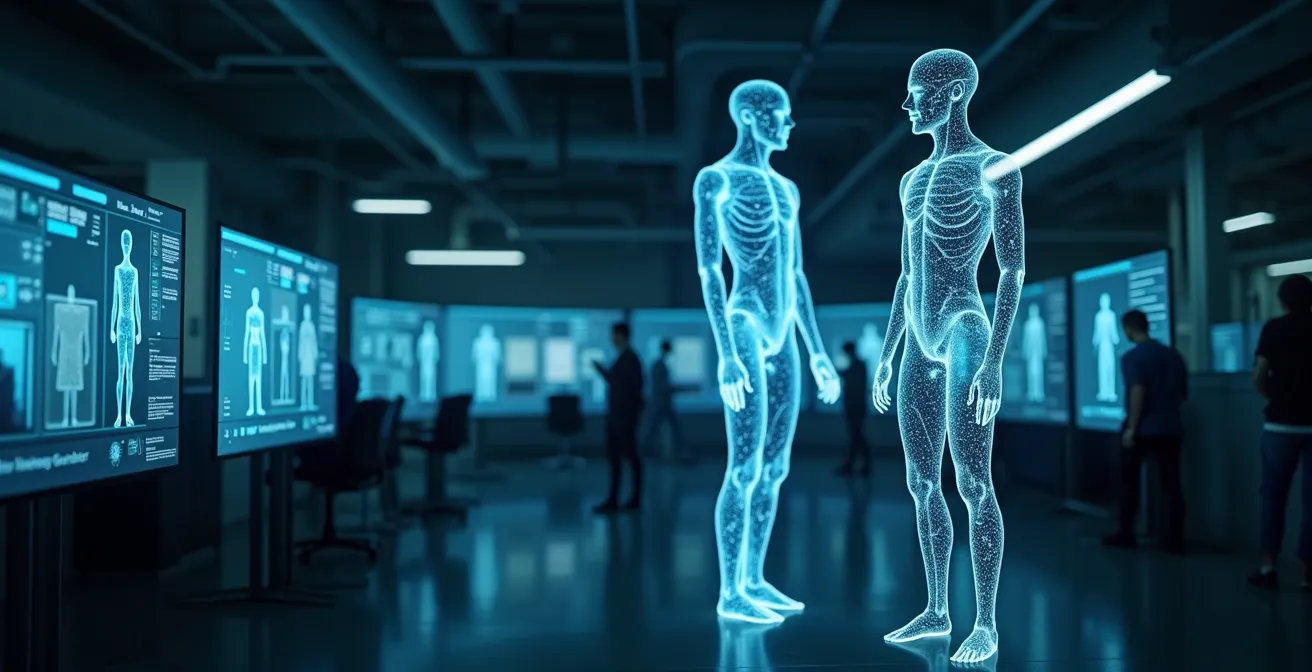
One of the greatest challenges in ergonomics is objectivity. A supervisor cannot be behind every employee, and occasional observations may miss the repetitive micro-movements that cause injuries. This is where artificial intelligence (AI) offers a major breakthrough. By using existing video streams from your security cameras, AI systems can continuously analyze work postures in a completely anonymized manner.
The system does not recognize faces; it focuses solely on detecting digital skeletons and joint angles. The AI can thus quantify, 24/7, how many times an employee bends more than 45 degrees, lifts their arms above their shoulders, or performs a trunk torsion. This objective data is then aggregated to create “heat maps” of ergonomic risks, identifying the stations and shifts most at risk without ever pointing a finger at an individual.
This technology directly addresses the fundamental principle of the Occupational Health and Safety Act (LSST) in Quebec, which states that the employer must take the necessary measures to protect the health and ensure the safety and physical integrity of the worker. AI becomes a tool for documented due diligence, proving that you are not just reacting to accidents, but actively and continuously analyzing sources of danger. These quantified reports are powerful arguments for justifying investments in workstation design or defending a case with the CNESST.
Lift table or vacuum lifter: which equipment for your 20 kg boxes?
Identifying a manual handling risk, such as the repetitive handling of 20 kg boxes, is one thing. Choosing the right assistance solution is another. A classic mistake is choosing equipment based solely on the purchase price without considering the overall operational context. The choice between a lift table and a vacuum lifter perfectly illustrates this dilemma, particularly relevant in the Montreal industrial context where old buildings sit alongside modern factories.
Case Study: Equipment Choice in the Saint-Laurent Industrial Park
Faced with palletizing tasks for 20 kg boxes, many companies in the Saint-Laurent industrial park—often located in buildings with low ceilings—turned to vacuum lifters. Although more expensive to purchase, these systems require less floor space and are faster for pick-and-place movements. An analysis conducted in this context shows that the CNESST supports this type of initiative via subsidy programs that can cover up to 50% of acquisition costs for manufacturing SMEs, making the investment much more accessible.
The decision must therefore rest on a multi-criteria analysis grid. A lift table is excellent for bringing an entire pallet to the right height, but it is slow and bulky. A vacuum lifter is fast, precise, and adapts to restricted spaces, but requires more extensive training. The following table summarizes the key points to guide your choice.
| Criterion | Lift Table | Vacuum Lifter |
|---|---|---|
| Initial Cost | $2,000 – $5,000 | $8,000 – $15,000 |
| Load Capacity | 500 kg – 2,000 kg | 50 kg – 200 kg |
| Floor Space Required | 2-4 m² | 1-2 m² |
| Low Ceiling Adaptation | Limited | Excellent |
| Handling Speed | Moderate | Fast |
| Training Required | Minimal | Moderate |
The risk of inadequate lighting on the quality and health of inspectors
Ergonomic risks are not limited to physical effort. Environmental factors, often underestimated, can have a devastating impact on employee health and production quality. Lighting is a perfect example. In the manufacturing sector, which employs a significant portion of workers in Quebec, quality control and inspection stations are particularly critical. According to the 2023 Quebec Industrial Barometer, the province had 441,000 employees in the manufacturing sector, many of whom depend on their visual acuity.
Insufficient lighting, glare, or poor color rendering forces the inspector to adopt awkward postures: leaning over, squinting, moving their head closer to the part. These postures, maintained for hours, are a direct cause of neck pain, headaches, and intense visual fatigue. Beyond discomfort, this inevitably leads to a decrease in alertness and an increase in quality errors, with potentially heavy financial consequences, especially in high-tech industries like aerospace, which is highly present in Montreal.

The Occupational Health and Safety Regulation (RSST) of Quebec is very clear on the required illuminance levels. It is not a simple suggestion, but a legal obligation. Here are the thresholds to respect for inspection tasks:
- General Inspection: A minimum of 200 lux is required.
- Fine Inspection and Quality Control: The level must be between 500 and 1000 lux.
- Precision Work (e.g., aerospace): Up to 1500 lux will be required with a Color Rendering Index (CRI) greater than 90 for perfect shade distinction.
Investing in high-quality, directional, and adjustable lighting is therefore not a luxury but a necessity to protect your inspectors’ health and guarantee your production quality.
When to survey employees on their pain: before or after the shift?
To act before the injury, an early indicator is needed. How do you measure a risk before it translates into an absence or a CNESST claim? The answer lies in measuring the employees’ perceived pain, but not just any way. Simply asking “Are you in pain?” is too vague. An employee might have chronic pain unrelated to work. The most effective method is the “delta-pain” survey.
The principle is simple and powerful: the employee is asked to rate their pain level on a scale of 0 to 10 for different body parts (back, shoulders, wrists) just before their shift, and then just after. The first measurement establishes their “baseline.” The second measures the direct impact of the task performed. The difference between the two, the “delta,” is the purest indicator of the biomechanical stress generated by the workstation. A delta that systematically increases for the same station is a clear warning signal that an MSD risk is developing.
Feedback: Implementing “Delta-Pain” in a Laval SME
A manufacturing company in the Laval region implemented this survey system in 2024. In just six months, analyzing the aggregated and anonymous data identified three critical workstations generating an average increase of 4 points on the pain scale during a single shift. Thanks to this precise information, targeted ergonomic adjustments were made. The result, as reported by the ASSTSAS, was a 25% reduction in CNESST claims on those specific stations the following year, proving the return on investment of the approach.
Beyond identifying risks, this method is a powerful due diligence tool. By continuously documenting that you measure risks and act when indicators degrade, you build a solid case that demonstrates your proactivity in prevention—a strong argument in case of a contested occupational injury.
How to integrate cobots on a manual assembly line without frightening employees?
The introduction of collaborative robotics, or “cobotics,” is an increasingly popular solution for eliminating the most taxing and repetitive tasks, which are major sources of MSDs. A cobot can handle screwing, sanding, or moving small loads, freeing the human operator for higher value-added tasks. However, the arrival of a robotic arm on an assembly line can generate anxiety and resistance if poorly managed. The fear of being replaced is a natural and legitimate human reaction.
The key to success lies not in the technology itself, but in the communication and integration strategy. It is imperative not to present the cobot as a solution to “improve productivity,” but as a tool to “improve health and safety.” The fact that, according to an analysis by Alliance Ergonomie, handling is linked to 56% of MSD-type injuries compensated by the CNESST, is a powerful argument for justifying the introduction of robotic assistance. The communication plan must be transparent and participatory, in three clear phases:
- Phase 1 – The “Why”: Organize meetings to present the direct benefits to employees. Emphasize the elimination of thankless tasks and the proven reduction in injury risks. Show that the goal is to preserve their long-term health.
- Phase 2 – The “How”: Involve operators in the process. Organize practical training, for example in partnership with technical CEGEPs like Saint-Laurent, and co-develop the layout of new collaborative workstations. Identify a “cobot champion” within the team who will be trained first and become the reference person.
- Phase 3 – The “What next”: Implement a plan to value new skills. Show employees that mastering cobotics opens up career advancement opportunities, such as becoming a robotic cell supervisor, with possible support from Emploi-Québec programs.
By transforming employees from passive subjects into actors of change, fear turns into engagement. The cobot is no longer a competitor, but a colleague taking over the tasks most damaging to health.
How to position extraction arms to capture 95% of welding fumes?
In many workshops in Montreal’s North Shore and elsewhere, welding is a daily activity. While the risks of burns or UV exposure are well known, those related to inhaling welding fumes are often underestimated or poorly managed. These fumes contain metallic particles and toxic gases that, in the long term, can cause serious respiratory diseases. Installing a source capture system is mandatory, but its effectiveness depends on a crucial detail: its positioning.
An extraction arm placed too far away is almost as useless as no extraction at all. To be effective, it must follow the “diameter rule.” This simple rule states that the distance between the fume source (the welding arc) and the capture hood opening should not exceed the diameter of that same opening. If the hood has a diameter of 30 cm, it must be positioned less than 30 cm from the weld.
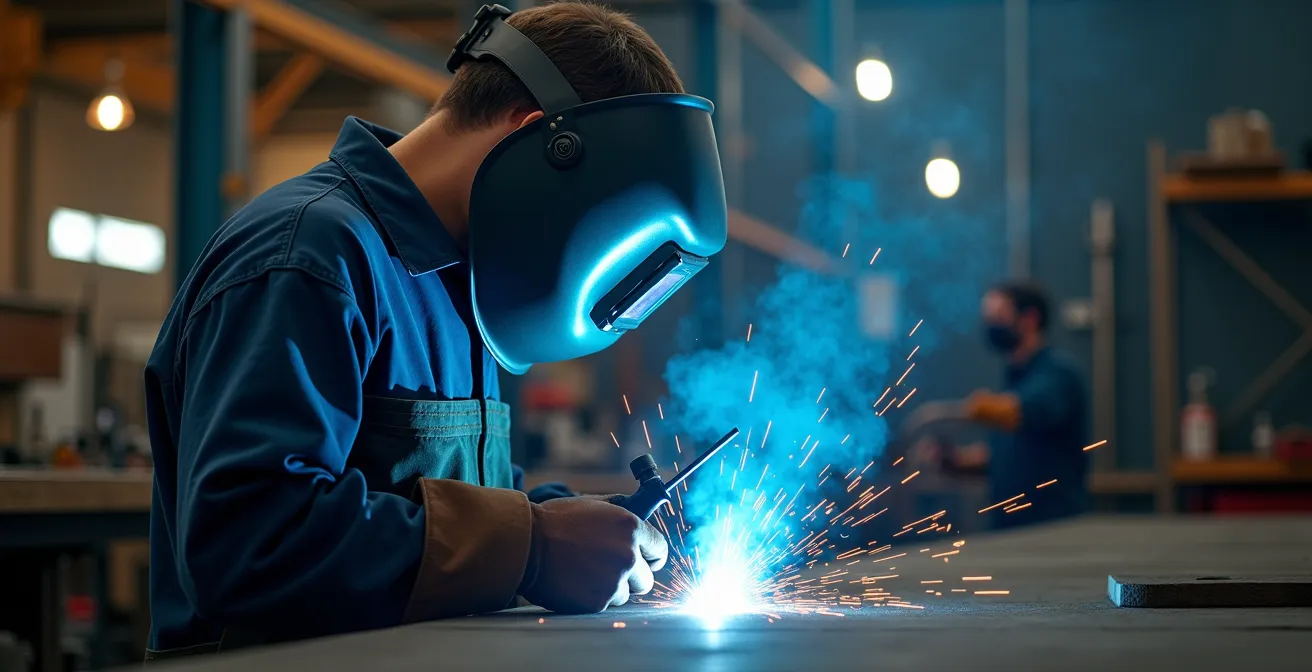
Failure to follow this simple rule is the most common cause of ineffective ventilation systems. Correct positioning increases capture efficiency from 60% to over 95%.
Case Study: Capture Optimization in a North Shore Workshop
A welding shop on Montreal’s North Shore performed smoke tests that revealed low efficiency in their capture system. By simply training welders to apply the “diameter rule” and adjusting the position of the articulated arms, capture efficiency jumped to 95%. For work on urban construction sites, where space is often confined, the company invested in mobile filtration units certified by ASP Construction, which maintain this optimal positioning even in difficult conditions, ensuring worker protection in all circumstances.
Training welders on this principle is therefore as important as buying the equipment. It is necessary to explain why this positioning is vital and provide them with the means to adjust it easily. A smooth and easy-to-manipulate articulated arm will be used correctly, while a rigid one will be cast aside.
Key Takeaways
- Task rotation is an illusion without a fine analysis of constraints by muscle group.
- Objective data (AI, delta-pain surveys) are key to moving from reaction to risk prediction.
- Documenting due diligence transforms prevention into a strategic asset before the CNESST.
Why contesting a CNESST decision can save your future premiums?
As an HR manager, receiving a CNESST decision accepting a claim for an MSD might seem like the end of the process. The next step is often managing the absence and absorbing the costs. However, it is crucial to understand that every decision has a financial impact that extends far beyond the direct cost of compensation. This is why analyzing and, if necessary, contesting a decision is a strategic management act. The CNESST pricing mechanism is complex: a claim for a lumbar sprain, for example, can have a considerable impact. According to CNESST data, a claim initially valued at $10,000 can cost the company up to $75,000 over 5 years via file imputation and increased personalized premium rates.
Contesting does not mean opposing the employee as a matter of principle, but ensuring that the injury is indeed work-related and correctly classified. Do you have proof that the station was analyzed and adapted (your documented due diligence)? Could the injury be related to a pre-existing personal condition? Contesting allows for opening a dialogue and presenting your case. If the contestation is upheld, even partially, the financial impact on your future premiums can be cancelled or significantly reduced.
The contestation process is rigorous and subject to strict deadlines. It is essential to know it so as not to lose your rights. Here are the main steps:
| Step | Deadline | Authority | Required Documents |
|---|---|---|---|
| Request for Review | 30 days | CNESST | Review form, medical evidence |
| Contestation at the TAT | 45 days after decision | Administrative Labor Tribunal | Application, complete medical file, testimonies |
| Hearing | 6-12 months | TAT | Independent medical expertise |
| Final Decision | 60-90 days post-hearing | TAT | Final written arguments |
All the prevention steps we have discussed (constraint mapping, AI analysis, delta-pain surveys) do not just serve to protect your employees; they constitute the evidence file that will support your contestation and protect your company’s financial health.
Frequently Asked Questions on Ergonomic Risk Identification
Why measure pain before AND after the shift?
The pre-shift survey establishes a baseline for chronic pains that may be unrelated to work. The post-shift survey measures the direct and immediate impact of the workstation. The difference between the two (the “delta”) becomes the purest indicator of the ergonomic risk generated by the task, isolating the effect of work from the employee’s general state of health.
How to guarantee the anonymity of worker responses?
Anonymity is crucial for obtaining honest data. Best practices include using a tablet or kiosk near the time clock with anonymous access codes for each employee. Data should never be presented individually, but always aggregated by department or station. Finally, the process must be validated with the Health and Safety Committee (HSC) and union representatives to build trust.
What is the legal value of these surveys before the CNESST?
While they do not constitute medical proof, these surveys are a key element in documenting the employer’s due diligence. In the event of a contested claim, they tangibly demonstrate that the company is proactive, continuously measures risks, and has a system to identify and correct problematic situations before they lead to an injury. It is proof of an active prevention culture.
To transform these strategies into a concrete action plan and justify your investments, the first step is to conduct a complete ergonomic diagnosis of your most critical workstations.