
Managing a factory remotely is not just about monitoring numbers; it’s about transforming data into effective management rituals.
- Overall Equipment Effectiveness (OEE) offers a more precise performance diagnostic than simple production volume.
- The key to team engagement lies in the clarity and interactivity of dashboards, sometimes through gamification.
Recommendation: Start by replacing a weekly paper report with a dynamic daily feedback loop with your team, focused on a single key indicator.
As an operations manager in Montreal, your daily life is a juggling act. Stuck in traffic on Highway 40, working from home, or visiting another site, the factory never stops. The promise of Industry 4.0 and smart dashboards seems like the miracle solution for maintaining control. Yet, many companies invest in cutting-edge technologies only to end up with screens full of numbers that no one really looks at, and decisions that are always made one step too late.
The common misconception is that technology alone solves the distance problem. You install software, connect sensors, and performance should follow. But what if the real key wasn’t the tool, but the way it transforms your management rituals? A cloud-based dashboard isn’t just a window into the workshop; it’s a powerful instrument for reinventing communication, energizing daily meetings, and empowering every team member, wherever you are.
This article is not a software catalog. It is a strategic guide for you, the manager. We will explore how to move from passive monitoring to active and intentional management. You will discover how to use data not to control, but to coach; how to transform a morning meeting into a powerful motivational lever; and how to make your dashboard the true heartbeat of your performance culture.
To navigate effectively through remote management strategies, this article is structured around the crucial questions managers ask themselves. The table of contents below will guide you toward the answers you need to transform your data into concrete actions.
Table of Contents: Mastering Your Factory Management with Smart Dashboards
- Why tracking Overall Equipment Effectiveness (OEE) is more useful than total volume?
- How to transition from a weekly paper report to minute-by-minute data?
- Industrial tablets or giant screens in the factory: which support for the team?
- The mistake of bombarding your managers with too many alerts that end up being ignored
- In what order should you go through KPIs during a “stand-up meeting” to energize the team?
- How to create a production dashboard that operators will actually look at?
- When to validate the savings of a Kaizen project with the finance department?
- How to use your production data to reduce material waste by 10%?
Why tracking Overall Equipment Effectiveness (OEE) is more useful than total volume?
In a context where Quebec’s manufacturing sector production increased by 0.6% in March 2024, the temptation is great to focus on a single figure: production volume. It’s a simple, rewarding, but deeply misleading indicator. Managing by volume is like driving while only looking at the speedometer, without paying attention to the fuel gauge or engine temperature. You could reach a record speed just before breaking down.
Overall Equipment Effectiveness (OEE), known as TRG in French, offers a much finer diagnostic. It breaks down performance into three critical factors:
- Availability: Did your machine run for all the scheduled time, or did it suffer unplanned stops?
- Performance: Did it run at its nominal speed, or were there micro-stops and slowdowns?
- Quality: Were all produced parts compliant on the first attempt, or were there rejects and reworks?
For a remote manager, OEE is not just an indicator; it’s a diagnostic tool. A high production volume can hide disastrous quality that will lead to hidden costs and customer dissatisfaction. Conversely, a declining OEE immediately points to the source of the problem: a spike in breakdowns (availability), an unstable rhythm (performance), or a setup issue (quality). You instantly know which lever to pull and what question to ask your team, transforming a simple observation into a targeted management action.
Focusing on OEE means moving from a culture of quantity to a culture of efficiency. It is the ultimate indicator for healthy and sustainable management because it measures your factory’s ability to produce well, not just a lot.
How to transition from a weekly paper report to minute-by-minute data?
The weekly production report, compiled manually, is a relic of a bygone era. It’s an autopsy: it records the performance of the past week but does nothing to influence it. The transition to real-time data is not just an acceleration; it’s a revolution in the managerial feedback loop. Instead of saying “last week, we lost 8 hours on Line 3,” you can now intervene the moment the loss occurs.
This transformation allows for a shift from reactive management to proactive management. Minute-by-minute data allows you to correct the trajectory during the shift. A machine stop longer than 5 minutes? An alert is sent. The cadence falls below the target threshold? The team leader can investigate immediately. This is the end of “driving looking in the rearview mirror.”
Case Study: JPB Système and Smartphone-Based Factory Management
The example of JPB Système, a French precision mechanics SME working for the aerospace industry, is enlightening. The company developed an application allowing its leader to remotely monitor production status in real-time via smartphone. Wherever he is, he can check performance, be alerted to deviations, and communicate with his teams. This demonstrates that real-time management is not reserved for large groups but is accessible and transformative even for SMEs.
For the operations manager, this means being able to ask relevant questions at the right time, even remotely. “I see a stop on Press 2 for the last 15 minutes, what’s happening?” is infinitely more effective than “Can you explain the production dip from last Tuesday?”. You become a real-time coach, and no longer just a historian of past performances.
Industrial tablets or giant screens in the factory: which support for the team?
Once data is available in real-time, the question of its dissemination becomes central. The choice of support is not trivial; it defines who accesses the information and how it is consumed. The two main options, rugged tablets and giant screens, are not competitors but complementary, as they serve different management rituals. The manufacturing sector is a pillar of the local economy, and in Quebec, it is notable that 40.2% of manufacturing jobs produced goods destined for final consumption in 2022—a field where responsiveness and collective visibility are master assets.
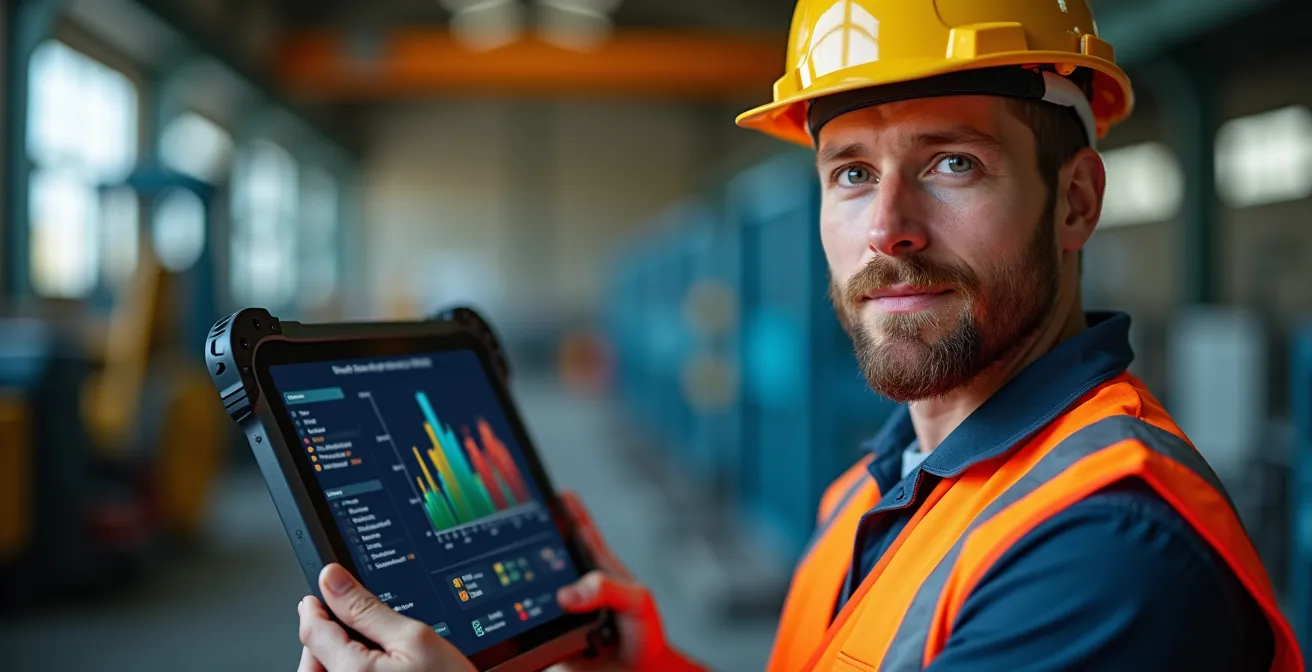
The rugged industrial tablet is the tool for mobile management. It is ideal for the team leader, supervisor, or operations manager moving through the factory or working remotely. It allows for individual analysis, deep dives into data, and discreet consultation of performance across multiple lines or sites. It is the instrument for asynchronous and personalized management.
The giant screen, positioned at a strategic crossroad in the workshop, plays a radically different role. It is a mass communication and collective management tool. Its primary function is to create shared situational awareness. At a glance, the entire team sees where they stand relative to the objective. It becomes the natural rallying point for “stand-up” meetings and anchors performance at the heart of the workspace.
The following table summarizes the strengths of each support to help you define the best combination for your factory.
| Criterion | Rugged Tablets | Giant Screens |
|---|---|---|
| Mobility | Excellent – for mobile supervisors and managers | None – installed at strategic fixed stations |
| Team Visibility | Individual, private | Collective – large board visible to all, promoting transparency |
| Initial Cost | Moderate per unit | High per screen |
| Primary Use | Detailed analysis, multi-line management, mobility | Mass communication, team rituals (stand-up), motivation |
| Maintenance | More frequent replacement, fleet management | Long lifespan, occasional maintenance |
The optimal strategy often involves equipping mobile managers with tablets for individual analysis and action, while using giant screens to lead collective rituals and keep the entire team aligned on the same goals.
The mistake of bombarding your managers with too many alerts that end up being ignored
With the ability to measure everything in real-time comes an insidious danger: “alert fatigue.” A poorly configured system can quickly transform a manager’s smartphone or inbox into an incessant stream of notifications: “Machine A stopped,” “Low cadence on Line B,” “Low stock level.” Initially, every alert triggers an action. Then, their volume becomes such that they are perceived as noise. Eventually, they are systematically ignored, completely canceling the benefit of the real-time system.
The goal is not to be alerted about everything, but to be alerted about what matters by the right person. Effective remote management relies on an intelligent escalation strategy. Not all problems have the same criticality or require the operations manager’s attention. A two-minute micro-breakdown should be managed by the operator. A 15-minute stop should go up to the team leader. Only a major breakdown exceeding one hour, or a recurring unresolved issue, should potentially escalate to the director.
Building this escalation system means defining clear rules: who is responsible for what, and within what timeframe. This empowers teams at every level and frees upper management to focus on strategic issues rather than operational micro-management. A good dashboard doesn’t just tell you there is a problem; it shows you that the problem is being handled by the designated person. To set up a notification system that informs without overwhelming, an audit of your current processes is indispensable.
Your action plan for a relevant alert system
- Identify trigger points: List all critical events (stops, quality drops, etc.) and define clear trigger thresholds for each (e.g., stop > 10 min, reject rate > 5%).
- Map the chain of responsibility: For each alert, define the Level 1 recipient (e.g., operator), Level 2 (team leader), and escalation conditions (e.g., if not resolved in 30 min).
- Centralize communication: Ensure all data and alerts come from a single source to avoid contradictory information and double entries, which can cost team leaders 30 to 45 minutes per day.
- Configure channels: Choose the right channel for each level of urgency. An SMS for a critical breakdown, an email for a shift report, a notification in the app for a minor deviation.
- Review and refine: Schedule a monthly review of the alert system. Are there too many “false positives”? Was a critical alert missed? Continuously adjust thresholds and rules.
Rather than trying to see everything, try to see only what requires your attention. That is the difference between being informed and being overwhelmed.
In what order should you go through KPIs during a “stand-up meeting” to energize the team?
The “stand-up” meeting or “floor walk” is the quintessential management ritual in a factory. It’s the moment the team synchronizes, analyzes recent performance, and prepares for the day. When led in front of a dashboard, the order in which you present Key Performance Indicators (KPIs) is not a detail. It must tell a story, create momentum, and reinforce company priorities.
A common mistake is to start with production or costs. This puts pressure on before ensuring the foundations are solid. A proven and extremely effective method is the SQCDP structure (or SQDC, or one of its variants). This acronym provides a logical and human narrative for the meeting:
- S for Safety: Always start with the human element. Were there any incidents, near-misses, or identified risks? By placing safety first, the company sends a clear message: employee well-being takes precedence over everything else. This is the foundation of trust.
- Q for Quality: Right after people’s safety comes product quality. Did we respect the standards? What is our reject rate? We ensure things are done right before trying to do them fast.
- C for Cost: Once quality is assured, we can talk about efficiency. Did we control our material consumption? Our energy usage? Cost is a consequence of good or bad process management.
- D for Delivery: This indicator measures our ability to deliver to the customer on time. Did we meet production targets? Is the schedule being followed? It only makes sense if quality is present.
- P for People: We finish by closing the loop on the human side. Who needs training? How can we improve team morale? This is the time to recognize successes, discuss friction points, and reinforce engagement.
Following the SQCDP order transforms a simple review of numbers into a structured dialogue that reinforces company culture at every meeting. For the remote manager, it is a powerful framework for ensuring that their teams, even without their physical presence, focus on the right priorities in the right order.
How to create a production dashboard that operators will actually look at?
The biggest failure of a dashboard is indifference. You can have the most accurate data and sophisticated graphics, but if the operators on the ground don’t pay attention, your investment is in vain. For a dashboard to be adopted, it must stop being a surveillance tool and become an aid and motivational tool. It must speak the operator’s language and answer a simple question: “How am I performing right now and how can I improve?”
To achieve this, two principles are essential: visual clarity and gamification. Visual clarity means using a simple “grammar”: universal colors (green for “good,” red for “problem”), gauge or speedometer-type indicators, and limiting each screen to 3 or 4 KPIs maximum. The operator should understand the situation in less than 3 seconds.
Gamification, on the other hand, leverages game mechanics to increase engagement. It’s not about turning the factory into an amusement park, but about introducing a spirit of healthy competition and a sense of accomplishment. As Mecalux’s analysis on the subject points out, gamification in logistics and production increases engagement by encouraging operators to get more involved, which guarantees better returns for the company.
Concretely, this can translate into:
- Real-time performance tracking: Allowing operators to see their own progress relative to a personal or team goal.
- Leaderboards: Displaying (anonymously or by team) the best performances on a specific indicator, such as OEE or the shortest changeover time.
- Badges and rewards: Virtually celebrating the achievement of goals (e.g., “10 days without an accident,” “production record broken”).
- Transparency of results: An environment where performance is visible to all creates positive stimulation and a sense of belonging to a collective effort.
By adopting these principles, the dashboard is no longer perceived as a management “snitch,” but as a personal coach helping the team win. This is the key to operators taking ownership and actively using it to improve their own work.
When to validate the savings of a Kaizen project with the finance department?
Launching a continuous improvement (Kaizen) project is one thing; proving its financial impact is another. The credibility of your improvement process and the justification for future investments rest on your ability to translate operational gains (a 5% reduction in cycle time, a 2% drop in rejects) into tangible financial gains (dollars saved). The production dashboard is your source of truth for quantifying these gains, but collaboration with the finance department requires a clear timeline and methodology. This validation is all the more strategic as revenue from goods manufactured in Canada reached $882.3 billion in 2023, a colossal figure where every percentage point of improvement has a significant impact.
Financial validation should not be a one-time event at the end of the year. It is a process that follows the rhythm of the company. A structured validation calendar allows for the alignment of operations and finance, avoiding unpleasant surprises.
The following table proposes a typical calendar to synchronize the tracking of gains between production teams and the finance department.
| Period | Type of Validation | Objective and Actions |
|---|---|---|
| Monthly | Operational tracking | The production team uses the dashboard to track improved KPIs (e.g., OEE, reject rate). The goal is to confirm that the operational gain is real and stable. |
| Quarterly | Budgetary validation | Data extracted from the dashboard is shared with finance. Operational gains are compared against cost standards for an initial estimate of savings. This is the time to review data and adjust budgets if necessary. |
| Annual | Full report and ROI | Finance consolidates quarterly gains to calculate the final Return on Investment (ROI) of the project. This official figure will be used to calculate bonuses, justify the following year’s improvement budget, and communicate successes. |
This three-step process ensures that production figures are understood and validated by finance, thereby giving incontestable weight to your improvement efforts. For the operations manager, it is the best way to prove their team’s value and secure resources to continue innovating.
Key Takeaways
- Overall Equipment Effectiveness (OEE) is a much more powerful operational health diagnostic than simply tracking production volume.
- Managerial rituals, such as the SQCDP-structured stand-up meeting, are essential for transforming dashboard data into collective actions.
- Sustained operator engagement depends on clear, visual, and interactive dashboards that promote a spirit of healthy competition and transparency.
How to use your production data to reduce material waste by 10%?
Reducing raw material waste is one of the most direct levers for improving a factory’s profitability. Aiming for a 10% reduction is an ambitious but realistic goal if based on a methodical approach guided by data. Your cloud-based dashboard is the first step: it acts like a nervous system that detects symptoms of waste, such as an abnormally high reject rate or overconsumption of material per unit produced.
However, data alone solves nothing. It indicates *where* to look, but not always *why* the problem exists. True efficiency comes from combining remote data analysis with field observation. This is where the concept of a targeted field walk (or “Gemba Walk”) comes in. Guided by alerts from your dashboard, you or your team leader can go precisely where an anomaly was detected to observe the process, dialogue with the operator, and identify the root cause of the waste—whether it’s a poor setting, a variation in raw material, or a work method that needs optimization.
The method to reach this reduction goal is divided into three phases:
- Quantify and Locate: Use your system to calculate the cost of materials and supplies by production line and by product. Identify the 20% of products that generate 80% of the waste.
- Analyze and Investigate: For each identified waste source, use historical data to spot patterns. Does the problem occur at the beginning of a shift? With a certain batch of material? Then, target your Gemba walks during these specific times.
- Act and Measure: Implement a corrective action (training, parameter modification, etc.) and use the dashboard to measure the impact in real-time. Has the reject rate dropped? The goal is to see the effect of your action on the graph by the very next day.

This rapid feedback loop, alternating between data analysis and field action, is the most powerful engine for sustainable waste reduction. It transforms an abstract 10% goal into a series of concrete and measurable actions.
To transform your factory’s management, the next step is to audit your current performance rituals and identify the first KPI to digitize to begin your transition toward data-driven management.