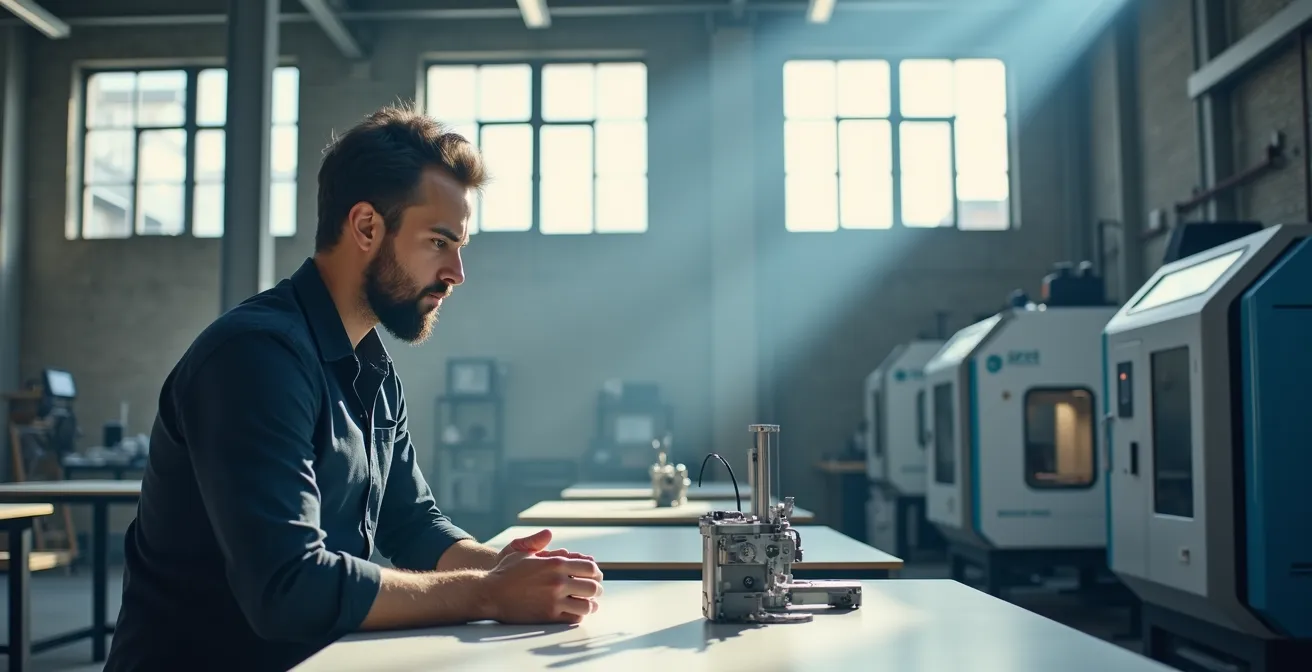
The biggest mistake hardtech founders make is believing their functional prototype is 90% of the final product; in reality, it is only 10% of the way there.
- Design for Manufacturing (DFM) is not an optimization, but a complete redesign dictated by the physical and financial constraints of molding.
- The Montreal ecosystem offers a unique advantage: specialized incubators like Centech provide access to expertise and equipment that make in-house hiring prohibitively expensive.
Recommendation: Stop perfecting your prototype. Your priority is to have its “industrial DNA” validated by experts and to secure a firm production quote before taking any other steps.
As an accelerator director, I see hundreds of hardtech startup founders every year. They all share the same spark in their eyes, the same pride when presenting their prototype, often the result of sleepless nights and countless iterations on a 3D printer. They think they’ve done the hardest part. That’s where my role, often a thankless one, begins: telling them they are standing on the edge of a abyss—the “manufacturability chasm.” It’s not just a simple step, but a complete paradigm shift that swallows most ill-prepared projects.
The common reflex is to think in technical terms: “How do I produce my part?”. We look for suppliers, ask for quotes, and get hit with astronomical costs. But the real question is strategic. Most generic advice focuses on intellectual property protection or seeking funding—valid points, certainly, but they often arrive too late. They ignore the root cause of failure: a product design that is fundamentally incompatible with profitable mass production.
What if the key wasn’t in the perfection of your prototype, but in your ability to anticipate and integrate factory constraints from the very first line of your CAD? This article is not just another guide on entrepreneurship. It is a strategic roadmap, designed for you, the Montreal founder, to help you cross this famous chasm. We will deconstruct the myth of the prototype, choose the strategic ally adapted to your industry, navigate the outsourcing dilemma, and finally, structure your financing so that your dream doesn’t shatter on the reef of the first purchase order.
To navigate these complex waters, this article is structured to guide you step-by-step, from fundamental design errors to advanced financing strategies. Explore the sections that interest you most or follow the path we have laid out to transform your vision into a commercial reality.
Summary: From Prototype Vision to Industrial Reality in Montreal
- Why is your 3D printed prototype impossible to mold industrially?
- Centech, CTS, or Next AI: Which incubator is specialized for your industry?
- Internalizing assembly or outsourcing to a Montreal “Job Shop”: The dilemma
- The risk of disclosing your design to a subcontractor without a solid contract
- When to launch pre-orders to finance the first production batch?
- Why collaborating with Centech or ÉTS is more cost-effective than hiring internally?
- How to structure a paid “Proof of Concept” (POC) with a private partner?
- How to stack federal and provincial subsidies for your factory without penalty?
Why is your 3D printed prototype impossible to mold industrially?
Your 3D printed prototype is a magnificent proof of concept. It validates a function, ergonomics, an idea. But on an industrial level, it often has no value. The reason is simple: 3D printing is an additive process (adding material layer by layer), while injection molding—the king of mass production—is a subtractive and formatted process (injecting material into a mold). This fundamental difference changes every rule of design. Walls that are too thin or too thick, perfect right angles, or complex details are easy to print but become technical nightmares in molding, creating defects, breakages, or requiring excessively expensive multi-part molds.
Cost is the ultimate judge. Moving from a prototype to mass production involves a massive initial investment in tooling. A detailed cost analysis shows that the price of a mold can vary from a few thousand to over $100,000 depending on its complexity. Every design “freedom” you allowed yourself with 3D printing, such as an undercut, can add tens of thousands of dollars to the tooling bill. This is what we call the industrial DNA of your product: it must be designed for mass production from the start. Ignoring this principle means designing a product that is dead on arrival commercially.
Design for Manufacturing (DFM) is therefore not an optimization step, but a design discipline in its own right. It involves rethinking every curve, every thickness, and every assembly based on the constraints of the machine that will produce it. For a startup, this expertise is rarely available in-house. This is precisely where the Montreal ecosystem comes in, giving you access to experts who can audit and correct your product’s DNA before you spend the first dollar on tooling.
Your action plan for a manufacturable design (DFM)
- Wall thickness: Analyze your 3D model and ensure that walls have a thickness as uniform as possible, ideally between 1 and 4 mm for most plastics.
- Draft angles: Inspect all vertical surfaces. Apply a minimum draft angle of 1 to 2 degrees to allow the part to be ejected from the mold without friction.
- Undercuts: Identify and eliminate all undercuts. If they are absolutely necessary, rethink the part in two pieces or prepare for a much higher mold cost.
- Aesthetic simplification: List cosmetic features (engraved logos, complex textures) and evaluate if they are essential. Every non-functional detail increases the complexity and cost of tooling.
- Material validation: Do not assume that the plastic from your 3D printer is the right one. Meet with a polymer expert to validate the final material based on mechanical, thermal, and regulatory constraints.
Centech, CTS, or Next AI: Which incubator is specialized for your industry?
The Montreal ecosystem is incredibly rich, but this abundance can be paralyzing. Choosing the wrong incubator is like planting a tropical seed in arctic soil: the environment is simply not adapted. Each incubator has its own investment thesis, network, and sectoral expertise. A Medtech startup does not have the same needs as an AI or advanced manufacturing startup. Your first strategic task is to identify the ally whose “business model” is aligned with yours. Don’t choose an incubator for its name, but for the relevance of its network and its program to your industry.

Centech, affiliated with the École de Technologie Supérieure (ÉTS), is, for example, a powerhouse in the fields of deep tech and advanced manufacturing. Their direct access to labs and the expertise of ÉTS engineers is a massive competitive advantage for a hardtech startup. Next AI, as the name suggests, is the gathering point for everything related to artificial intelligence. District 3, linked to Concordia, has a strong focus on health and social impact. Every door you open will lead you down a different corridor; make sure it’s the one that leads to your future customers, partners, and investors.
This comparison table offers an overview to start your analysis. Your mission is to go further: contact startups that have gone through these programs. Ask them what the real value was, beyond the marketing talk. The perfect incubator is the one that has already solved the problem you are about to face 100 times over.
| Incubator | Specialization | Affiliation | Program Duration |
|---|---|---|---|
| Centech | Deep tech, Medtech, Manufacturing | ÉTS | 12 weeks (Acceleration) + 24 months (Propulsion) |
| District 3 | Health, Bio, Tech, Social | Concordia | Variable depending on program |
| MT Lab | Tourism, Culture, Entertainment | ESG-UQAM | Variable |
| CEIM | Digital technologies, Life Sciences | Independent | Flexible |
Internalizing assembly or outsourcing to a Montreal “Job Shop”: The dilemma
Once your design is validated for manufacturing (DFM), the next dilemma arises: should you invest in your own assembly line or entrust production to a specialized subcontractor, a “job shop”? For a startup, the answer is almost always to outsource. Attempting to internalize production at this stage is a classic mistake that diverts precious capital (money and time) toward non-essential operations. Your job is not to manage a factory, but to develop your technology and your market.
Quebec, and Montreal in particular, has a dense industrial fabric of extremely competent “job shops”—SMEs specializing in machining, plastic molding, electronic assembly, etc. These partners already possess the equipment, expertise, and certifications. The tooling dilemma is at the heart of this decision. An injection mold for a medium-sized production run can cost between $2,500 and $5,000 for 5,000 to 10,000 units. A subcontractor amortizes this cost over many clients and can often offer more agile and less expensive solutions to get started.
Choosing the right partner is crucial. Look for more than just an executor. A good subcontractor becomes an extension of your R&D team. They will help you further optimize your design, choose the right materials, and anticipate quality issues. It is an invaluable transfer of risk and gain in expertise.
Case Study: Plastique Age’s expertise at the service of startups
Plastique Age, a recognized Montreal manufacturer, perfectly illustrates the value of a local partner. Having achieved an exceptional quality standard (0 PPM – Part Per Million defect) for a recreational vehicle giant, they bring this expertise to companies transitioning to plastic injection. By guiding startups through the complexities of the process, they don’t just produce parts; they increase their clients’ competitiveness by sharing cutting-edge industrial experience.
The risk of disclosing your design to a subcontractor without a solid contract
The decision to outsource opens the door to a major risk: the loss of your intellectual property (IP). You are about to share detailed plans of your innovation with an external partner. Without a bulletproof legal framework, you expose yourself to seeing your design copied, improved without your consent, or worse, sold to a competitor. The excitement of launching production must never overshadow this reality. A simple handshake or a standard non-disclosure agreement (NDA) downloaded from the internet is an illusion of protection.
Your subcontracting contract is as important as your patent. It must be drafted by a lawyer specializing in IP and commercial law, ideally with experience in the manufacturing sector. This document must go far beyond confidentiality. It must precisely define who owns what, particularly the improvements made to the design by the subcontractor. This is an often-overlooked point: if your partner, through their expertise, optimizes a part, who owns that improvement? Without a clear clause, the answer could be unfavorable for you.
The contract must also include deterrent penalties for breaches, exclusivity clauses to prevent your partner from working for a direct competitor, and clear conditions on the ownership and transfer of tooling (the molds) if you decide to change suppliers. Consider this legal investment not as an expense, but as insurance for your company’s future value. A weak contract can turn your production partner into your biggest competitor.
Here are the clauses that must absolutely appear in your manufacturing subcontracting contract:
- Robust Non-Disclosure Agreement (NDA): It must include clearly defined financial penalties in case of information leaks, high enough to be a deterrent.
- Intellectual Property of Improvements: The clause must stipulate that any modification or improvement of the design, even if initiated by the subcontractor, remains the exclusive property of your company.
- Exclusivity and Non-Compete: Define a period and a scope (geographical or sectoral) during which the subcontractor agrees not to work for direct competitors.
- Timeline and Delay Penalties: A detailed production schedule with clear milestones and penalties applicable for failure to meet deadlines is essential.
- Right to Audit and Quality Control: You must reserve the contractual right to visit the facilities and perform quality checks at any stage of the process.
- Termination Conditions and Tooling Transfer: The contract must provide for terms of ending the collaboration, guaranteeing your right to physically recover all your tooling (molds, jigs) without delay.
When to launch pre-orders to finance the first production batch?
Launching a crowdfunding campaign (like Kickstarter) or opening pre-orders to finance the first production batch is a very popular strategy. It’s an excellent way to validate market appetite and generate cash flow before even producing a single unit. However, the timing of this launch is one of the most critical decisions you will have to make. Launching too early can be fatal, as can launching too late.
The most common mistake is to launch the campaign based on your prototype and a cost estimate. This is a recipe for disaster. If, after a successful campaign, you discover that your product is not manufacturable as-is or that the tooling cost is three times your estimate, you find yourself in an impossible situation: unable to deliver to your customers, with a destroyed reputation and potentially legal obligations.

The golden rule is simple: never launch pre-orders before having a firm and binding quote from your subcontractor for the tooling and production of the first batch. This means you must have completed the DFM (Design for Manufacturing) cycle and your partner has validated your production plans. This firm quote becomes the foundation of your financial goal. You know exactly how much you need to raise to produce and deliver, including a safety margin (typically 20-30%) for the unexpected.
The ideal time to launch your campaign is in a specific window: after DFM validation and obtaining the quote, but before signing the purchase order for the tooling. The pre-sale campaign then becomes the ultimate market validation and the tool to finance this major investment. This approach requires patience, but it significantly de-risks the operation and ensures the trust of your first customers.
Why collaborating with Centech or ÉTS is more cost-effective than hiring internally?
For a hardtech founder, the temptation is great to want to master everything in-house, notably by hiring engineers to develop the product. At first glance, this seems to guarantee control and speed. This is a costly illusion. The main obstacle for a startup is not technical competence, but access to two rare and expensive resources: cutting-edge equipment and diverse industrial experience. This is where collaboration with a structure like Centech, backed by ÉTS, becomes an obvious financial and strategic choice.
Let’s calculate the return on investment. Hiring a senior mechanical engineer in Montreal represents an annual loaded cost of well over $100,000. And this engineer will need tools: software licenses, test benches, and most importantly, access to a fleet of machines for prototyping. The Centech Propulsion program offers, for a fraction of this cost, access not only to an on-site fabrication workshop with 3D printers and other equipment but also to multiple specialized ÉTS laboratories. This is a huge leverage effect: you access millions of dollars in infrastructure for the cost of a fraction of a single salary.
But the advantage goes beyond hardware. The ecosystem of a university incubator exposes you to a constant flow of experts, research professors, and other founders who have faced similar challenges in different industries. This cross-pollination of ideas has invaluable value. A problem that seems insurmountable to you might have already been solved in the aerospace or biomedical fields. As Richard Chénier, Director General of Centech, pointed out during its rapid growth, the accelerator positions itself at the convergence of multiple cutting-edge domains. This exposure to diverse expertise is something no startup can afford to recreate in-house.
How to structure a paid “Proof of Concept” (POC) with a private partner?
One of the biggest challenges for a B2B startup is financing the technology validation phase with a first customer. The reflex is often to offer a free pilot project in the hope of landing a contract. This is a risky strategy that devalues your technology and consumes your resources. A much more powerful approach, characteristic of more mature startups, is to structure a paid “Proof of Concept” (POC). The goal is to ensure your industrial partner co-invests in proving the value of your solution.
In Montreal and Canada, there are brilliant funding mechanisms to catalyze these partnerships, notably the Mitacs Acceleration program. This program allows a company to partner with a university (via a master’s, doctoral, or postdoctoral intern) for an R&D project. The partner company invests an amount (e.g., $7,500), which is then matched by Mitacs and governments, creating a much larger project budget. For your startup, it’s a winning strategy: you have your R&D financed by your first potential customer while demonstrating your technology’s value in their own environment.
Structuring such an agreement must be meticulous. It’s not just a technical project, but a commercial agreement. You must define clear deliverables and measurable success criteria that, if met, will ideally trigger a new phase of collaboration. It is also crucial to negotiate IP aspects: a limited usage license for the duration of the test and a right of first refusal on the purchase or license of the developed technology are standard clauses to protect your interests. Following these steps transforms a cost center (the pilot) into a profit and strategic validation center.
The Business Development Bank of Canada (BDC) emphasizes the importance of these co-funding programs as a major lever. Here are the key steps to achieve this:
- Identify the right partner: Target a private company with an active innovation cell and a budget for exploratory projects.
- Define success criteria: Co-construct a list of measurable KPIs with the partner that, if achieved, will prove your solution’s value.
- Propose Mitacs co-funding: Present the Mitacs Acceleration program as an opportunity to multiply their initial $7,500 investment for a 4-month internship.
- Negotiate a limited license: Grant a license to use your technology strictly limited to the duration and scope of the POC.
- Include a right of first refusal: Give your partner priority (but not the obligation) to negotiate a commercial license if the POC is a success.
- Recruit via the program: Hire a highly qualified university intern via the program to execute the project under your and the partner’s supervision.
Key Takeaways
- Your 3D prototype is not a product. Design for Manufacturing (DFM) is a mandatory redesign, not an optimization.
- The Montreal ecosystem is your best asset. Access to equipment and expertise from incubators like Centech is more cost-effective than any hire.
- Tooling financing is key. Never launch pre-orders without a firm and binding production quote from a subcontractor.
How to stack federal and provincial subsidies for your factory without penalty?
Navigating the maze of government aid is an art that the wisest founders master. Canada, and Quebec in particular, offer a multitude of programs to support innovation and manufacturing. However, a fundamental rule is often misunderstood: the stacking of public aid. You cannot simply add up subsidies indefinitely. There is a cap that, if exceeded, can lead to penalties or the repayment of funds received. The strategy is not to apply everywhere, but to orchestrate intelligent “subsidy arbitrage.”
In Quebec, the general rule is that the combined government aid for a single project cannot exceed a certain percentage of eligible expenses. While the exact figure can vary, analyses of Quebec programs indicate a maximum stacking limit often around 75%. This means if you get an IRAP (PARI) grant covering 80% of salaries and a provincial SR&DE (RS&DE) tax credit, you must ensure the combined total does not exceed this threshold for the same expenses. It is crucial to distinguish programs that apply before expenses (direct grants like IQ’s Innovation Program) from those that apply after (tax credits like SR&DE).
The key is to break down your expenses and strategically assign them to the most advantageous programs. For example, R&D salaries can be partially covered by IRAP, with the remainder being eligible for SR&DE. An intern’s costs can be financed by Mitacs. Equipment purchases can be supported by the Innovation Program. Every dollar spent must be mapped to maximize the aid received without ever exceeding the authorized stacking cap. This is a complex task that often requires help from financing experts or your accelerator.
This table, inspired by sources like the CCTT Network, summarizes the main complementary programs. It illustrates the need to think in terms of a financing portfolio rather than a silo.
| Program | Organization | Type of Aid | Coverage | Timing |
|---|---|---|---|---|
| IRAP (PARI) | NRC | Direct grant | 80% salaries, 50% subcontractors | BEFORE expenses |
| SR&DE (RS&DE) | Federal/Provincial | Tax credit | Up to 35% of eligible expenses | AFTER expenses |
| Innovation Program | Investissement Québec | Grant | Up to $500,000 per project | BEFORE expenses |
| Mitacs Acceleration | Mitacs | Internship co-funding | $15,000 for 4 months | During project |
The transition from prototype to mass product is less a technical sprint than a strategic marathon. By integrating industrial constraints from the design phase, allying with the right partners in the Montreal ecosystem, and intelligently orchestrating your financing, you transform a path full of obstacles into a roadmap for success. To put this advice into practice, the next step is to obtain a personalized analysis of your situation from experts who have already guided hundreds of startups like yours.