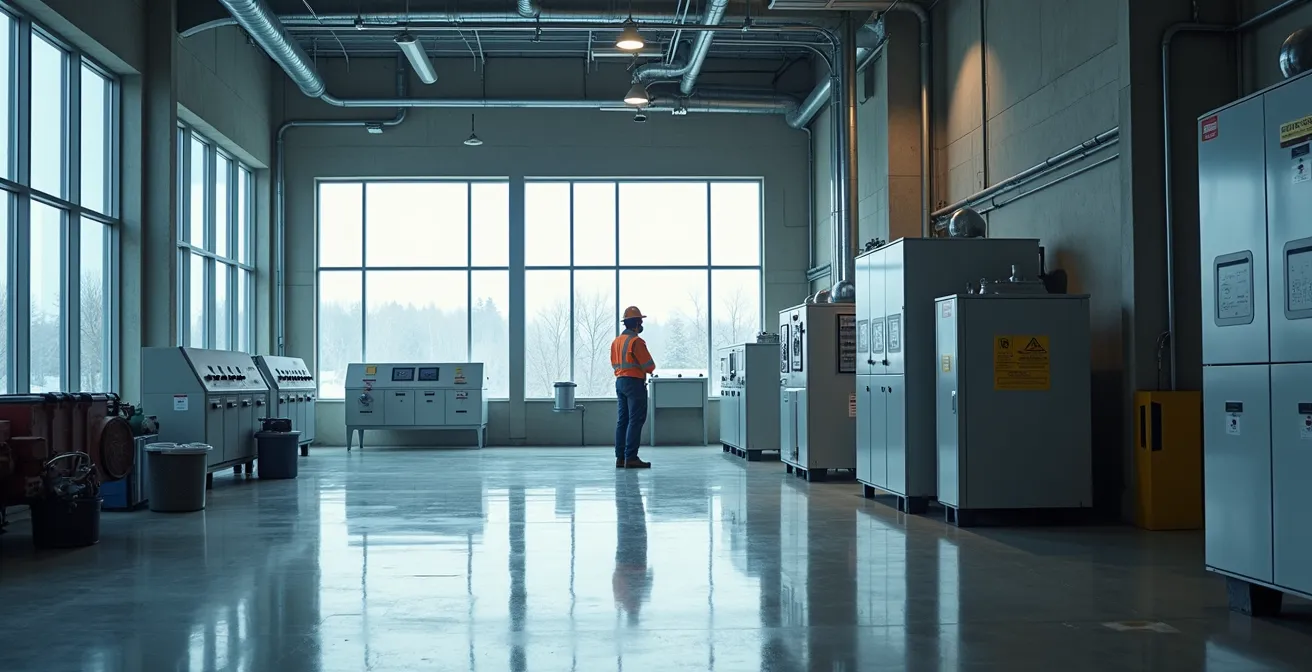
Complying with CNESST air quality standards is not an expense, but a strategic investment that directly protects your bottom line.
- A single occupational injury related to air quality can double your CNESST premiums for 4 years.
- Modern, well-chosen capture and filtration technologies generate substantial energy savings.
- Recommendation: Adopt a “compliance engineering” approach to not only avoid sanctions but also to improve your operational and financial performance.
As a Health and Safety Manager in Montreal, you have likely felt this pressure: an email from the CNESST announces an update to the Occupational Health and Safety Regulation (OHSR/RSST), with stricter Exposure Limit Values (ELV) for a substance present in your plant. The common reflex is to see this as a new constraint, an unavoidable expense to update a ventilation system or install a new filter. We think “compliance” and “cost,” rarely “opportunity.”
Most articles simply repeat that you must “install source capture” or “respect standards.” This advice, while correct, consists of platitudes. It ignores the complexity of your role, which is to protect employees while justifying every dollar spent. What if the real key wasn’t to endure regulation, but to master it? What if every technical decision regarding air quality—from the positioning of a capture arm to the selection of a filter media—was seen as a strategic lever?
This article adopts that perspective. As an industrial hygienist, my goal is not to list regulations for you, but to give you the keys to transform air quality management into a competitive advantage. We will analyze how informed technical choices can not only guarantee compliance but also reduce your operating costs, drastically decrease your financial risk related to the CNESST, and even improve your productivity. We will see how an integrated approach, linking airflow, fire safety, and ergonomics, constitutes your company’s best defense.
This article is structured to guide you, step-by-step, in building a robust and profitable air quality strategy. Explore the sections that interest you most or follow the full guide for total mastery of the subject.
Summary: The Strategic Guide to Factory Air Quality Facing CNESST Requirements
- Why do Exposure Limit Values (ELV) change and how do they impact your obligations?
- How to position capture arms to extract 95% of welding fumes?
- Cartridge or baghouse filter: which system for combustible dust?
- The risk of ignoring NFPA standards for your aluminum or wood dust
- How to recover heat from your exhausted air to heat the factory in winter?
- Why can a single injury double your premiums for 4 years?
- How AI analyzes your surveillance videos to detect poor postures?
- How to identify ergonomic risks before they cause musculoskeletal disorders?
Why do Exposure Limit Values (ELV) change and how do they impact your obligations?
Exposure Limit Values (ELV) are not figures set in stone. They are the result of constant scientific monitoring of substance toxicity. A new study can reveal that a product, previously considered low-risk, is actually more harmful than thought. The CNESST then integrates this new data into the RSST, lowering the ELV and placing you, sometimes overnight, in a potential non-compliance situation. Manganese, often present in welding fumes, is a perfect example. Recent controls show it is one of the contaminants for which the highest proportion of exceedances is observed. According to some regulatory analyses, for certain chemical agents, more than 15% of measured concentrations exceed the PEL (Professional Exposure Limit).
This constant evolution forces you to move from a reactive logic to proactive chemical risk management. The arrival of a new ELV triggers a strict regulatory countdown. Under the RSST, you generally have specific deadlines to act: identify at-risk stations, determine corrective measures, and implement them. The mistake would be to wait for the deadline. A wise strategy consists of anticipating these changes by maintaining a watch on the substances used and regularly evaluating the effectiveness of your control systems.
The key is to consider your ventilation systems not as a fixed installation, but as a process of continuous improvement. A tightening ELV is not a problem; it is a performance indicator signaling that optimization is necessary. This may involve a simple adjustment of airflows, a modification of work methods, or, in more complex cases, a partial redesign of your capture system. The goal is to always maintain a significant safety margin between your exposure measurements and regulatory limits, thus protecting you from future revisions.
How to position capture arms to extract 95% of welding fumes?
Effective capture of welding fumes is a science of precision, not brute power. The most frequent error is believing that a large fan will compensate for poor positioning. In reality, the effectiveness of a capture arm decreases exponentially with distance. The golden rule is simple: the arm’s hood must be placed at a distance equivalent to 1 or 2 times the hood’s diameter, generally between 15 and 30 centimeters from the welding arc, and positioned to intercept the smoke plume before it reaches the welder’s breathing zone.
The choice of technology is also crucial. We often contrast high volume/low pressure systems (conventional arms) with low volume/high pressure (LVHP) systems, often integrated directly onto the welding gun. Each solution has its place, but the application context is decisive.
Case Study: The Effectiveness of Low Volume/High Pressure (LVHP) Systems
An analysis by MultiPrévention perfectly illustrates the advantage of LVHP systems in certain contexts. For processes like GMAW, FCAW, and MCAW, guns with integrated capture ensure continuous extraction directly at the emission source. These systems only require about 100 cubic feet per minute (cfm) per station, compared to much larger volumes for traditional arms. Smaller diameter ducts (1.5 to 4 inches) make the equipment more maneuverable, reduce visual obstruction for the welder, and guarantee constant protection, even when the workpiece is complex.
Ergonomics and airflow are inseparable. A capture arm, even if perfectly sized, will be useless if it is too heavy, difficult to adjust, or if it hinders the welder’s movements. They will eventually stop using it. It is therefore imperative to choose articulated arms that are well-balanced and easy to manipulate, and above all, to train operators on their optimal positioning. A 15-minute practical training session directly at the workstation has more impact than hours of theory.
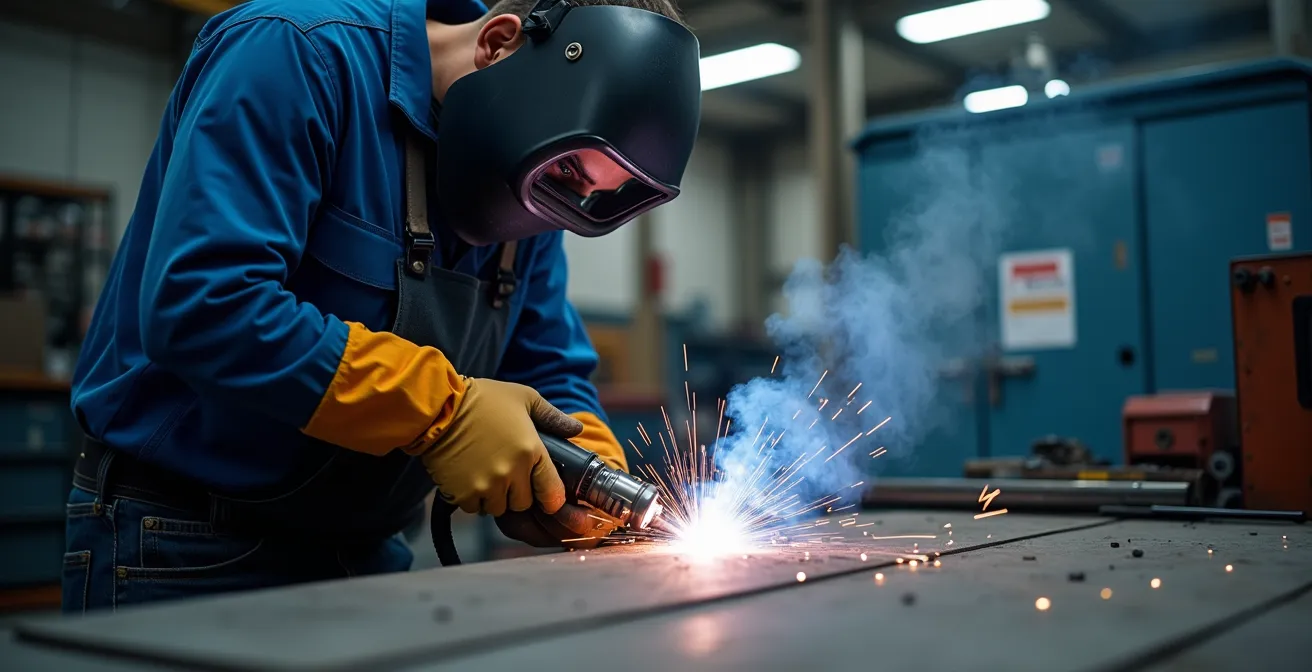
This image perfectly illustrates the expected result: the smoke plume is immediately sucked in, leaving the work area and the operator’s breathing zone perfectly clear. Investing in training for proper positioning is as profitable as investing in the equipment itself.
Cartridge or baghouse filter: which system for combustible dust?
Choosing a dust collector for combustible dust such as aluminum, wood, or certain composites is one of the most critical decisions in H&S. It’s not just about filtration, but about explosion prevention. The two dominant technologies, cartridge filters and baghouse filters, have advantages and disadvantages that depend directly on the nature of your contaminant and your operations. A poor choice can not only be ineffective but also create a major risk.
Cartridge filters, with their pleated media, offer a very large filtration surface in a compact volume. They are excellent for fine, dry dust, typical of finishing operations like aluminum sanding. Their filtration efficiency for submicron particles is often superior. However, their media can be more sensitive to hygroscopic or clogging dust, and the differential pressure required for pulse-jet cleaning can lead to higher energy costs.
Baghouse filters, on the other hand, are the champions of robustness. They are particularly suitable for large volumes of dust and coarser or fibrous particles, like wood chips in a furniture factory. Their simpler design often makes them more tolerant of difficult conditions, and their maintenance, although less frequent, can be more laborious. From an energy standpoint, they can sometimes operate with a more stable and therefore more economical pressure drop over the long term.
The decision cannot be made without an in-depth analysis of your dust (particle size, combustibility, abrasiveness) and your processes. The following table, inspired by Quebec’s industrial realities, summarizes the key points to consider.
| Criterion | Cartridge Filter | Baghouse Filter |
|---|---|---|
| Ideal Application | Fine aluminum dust (Mirabel aerospace) | Large volumes of chips (South Shore furniture plants) |
| Filtration Efficiency | 99.9% for particles < 1 micron | 99% for particles > 5 microns |
| Hydro-Québec Energy Cost | Higher (differential pressure) | Lower (constant flow) |
| NFPA Compliance | Explosion vents required | Suppression system recommended |
| Maintenance | Cartridge replacement every 12-18 months | Bag replacement every 24-36 months |
Beyond the technological choice, compliance with NFPA (National Fire Protection Association) standards, incorporated by reference in the Quebec RSST, is non-negotiable. The dust collector must be equipped with explosion protection systems, such as explosion vents, suppression systems, or isolation systems, correctly sized and installed.
The risk of ignoring NFPA standards for your aluminum or wood dust
Talking about combustible dust can seem abstract until you understand the devastating potential of a dust explosion. The risk is not hypothetical; it is real, and the consequences are catastrophic, both humanly and materially. Ignoring or neglecting NFPA standards, made applicable in Quebec by the RSST, is not an option. It is a bet your company cannot afford to lose.
For a dust explosion to occur, five elements must be present: this is the explosion pentagon. It requires fuel (dust), an oxidant (oxygen in the air), an ignition source (a spark, a hot surface), the dispersion of dust into a cloud, and confinement (a silo, a duct, a building). Your dust collector and its ducts are, by definition, confined environments where a dust cloud is constantly present. All that’s missing is the ignition source.
Case Study: Lessons from the British Columbia Explosions
In 2012, two sawmills in British Columbia were destroyed by pine dust explosions, causing several deaths and numerous injuries. These tragedies served as an electric shock to the industry. The investigation revealed accumulations of fine, dry dust on high-level surfaces. Following these events, the provincial body WorkSafeBC required all sawmills to conduct risk assessments, implement strict control programs, and train personnel. These requirements directly reflect the principles of NFPA standards, which are also cited in articles 54 to 60 of the RSST in Quebec.
Expertise on the matter is clear and unanimous across Quebec. As Hugues Châteauneuf, a recognized engineer and specialist in the field, points out:
In Quebec, we are the only province to directly integrate NFPA standards related to explosion risk management into our regulations. CNESST inspectors are trained to identify situations deemed dangerous and are likely to demand a halt to operations until corrective measures are in place.
– Hugues Châteauneuf, Mechanical Engineer and Explosion Protection Specialist
For an H&S manager, it is vital to know what a CNESST inspector or the Montreal Fire Department (SIM) will look for. It’s not about knowing every detail of the standard, but about recognizing the “red flags” that signal an imminent danger.
Your Action Plan: Points Checked by an Inspector
- Visible Accumulation: Is there a layer of dust more than 3 mm thick (the thickness of a quarter) on structural frames, on top of ducts, or on high-level equipment?
- Grounding: Are all components of the dust collection system (ducts, dust collector, silos) properly grounded to dissipate static electricity?
- Explosion Protection: Are explosion vents directed towards a safe zone, unobstructed, and has their sizing been validated by an engineer?
- Dust Hazard Analysis (DHA): Do you have a documented and updated Dust Hazard Analysis, as required by the NFPA-652 standard?
- Control of Ignition Sources: Do you have a program to control hot work, non-compliant electrical equipment, or mechanical friction near the system?
How to recover heat from your exhausted air to heat the factory in winter?
Every cubic foot of contaminated air you extract from your factory in winter is air you have paid to heat. Exhausting it outside is literally throwing money out the window. For Quebec factories, where heating costs represent a significant portion of energy expenses, heat recovery from air exhausted by ventilation systems is no longer a luxury, but an economic and ecological necessity.
The principle is simple: before expelling stale, warm air outside at -20°C, it is passed through a heat exchanger. This exchanger uses the energy from the outgoing air to preheat the incoming fresh air needed to compensate for the extracted air. Instead of pulling in freezing air and having to heat it from -20°C to 18°C, your heating system might only need to warm it from 5°C to 18°C. The savings are direct and substantial.

The efficiency of these systems, often exceeding 70%, means that the majority of thermal energy is recovered. For an H&S manager, this is a strong argument. Investment in a dust collection or fume capture system, often perceived as a mere cost center, can suddenly generate a measurable return on investment through energy savings. It’s a way to transform a health and safety obligation into an energy performance project.
Furthermore, the Quebec government, via programs like ÉcoPerformance, and Hydro-Québec, with its energy efficiency programs, offer attractive subsidies for this type of project. It is not uncommon for these grants to cover a significant part of the initial investment. For example, it is estimated that ÉcoPerformance subsidies can cover up to 75% of eligible expenses for heat recovery projects. Similarly, Hydro-Québec’s Efficient Solutions program offers concrete financial support. According to estimates from this program, financial incentives for heat recovery can reach approximately $620 per 100 CFM of air saved, making the profitability calculation even more favorable. Your H&S project becomes a green project, partially financed by public funds.
Why can a single injury double your premiums for 4 years?
The financial impact of poor air quality is not limited to the cost of ventilation equipment. The most insidious and costly risk is that of an occupational injury recognized by the CNESST. Whether it is occupational asthma, chronic obstructive pulmonary disease (COPD) due to fumes, or silicosis, the financial consequences for your company are direct, brutal, and long-lasting.
The CNESST pricing system is based on a retrospective calculation method. This means that an injury occurring today will impact your personalized premium rate for the next four years. A single costly occupational disease can be enough to push your financial record out of your classification unit’s average, resulting in a significant surcharge that can, in some cases, double your annual premium. It is a financial Sword of Damocles that makes inaction extremely perilous.
The argument that “prevention is expensive” does not hold up against a rigorous risk calculation. As demonstrated by an analysis by Environnement S-AIR, beyond potential fines and lawsuits, the impact on the personalized rate is the real financial lever. A failure to meet air quality standards that leads to an occupational disease directly engages the employer’s responsibility and activates this 4-year retrospective mechanism, transforming an “oversight” into a recurring financial burden.
Let’s put this into perspective. Investing in a source capture system may seem significant, but it is a one-time capital expense, often subsidizable. In comparison, the costs associated with an occupational disease are multiple and spread over time. The following table illustrates this gap strikingly.
| Cost Item | Source Capture System | One Occupational Disease (Asthma, Silicosis) |
|---|---|---|
| Initial Investment | $50,000 – $150,000 | $0 |
| CNESST Surcharge (4 years) | $0 | $80,000 – $200,000 |
| Personnel Replacement | $0 | $40,000 – $60,000 |
| Lost Productivity | $0 | $30,000 – $50,000 |
| Total Cost (4 years) | $50,000 – $150,000 | $150,000 – $310,000 |
| Prevention ROI | Positive by Year 2 | Negative for at least 4 years |
The conclusion is clear: preventive investment is not a cost; it is insurance against a major financial risk. Every dollar invested in an effective ventilation system is a dollar that protects your balance sheet from the devastating impacts of an occupational injury.
How AI analyzes your surveillance videos to detect poor postures?
Artificial intelligence is no longer science fiction; it is becoming a concrete and powerful tool for H&S managers. One of its most promising applications is postural analysis via computer vision. By using already existing surveillance cameras (while respecting privacy), AI algorithms can now analyze worker postures in real-time to identify high-risk movements before they cause musculoskeletal disorders (MSDs).
Imagine a system that automatically detects that an operator is bending excessively and repetitively to reach their part, or that a handler is lifting loads using their back rather than their legs. The system does not aim to “monitor” the employee, but to objectively assess a risk. It can generate aggregated and anonymized data—heat maps of risk zones, statistics on the most frequent dangerous movements—providing you with a factual basis to redesign a workstation or target training.
The most interesting aspect for an industrial hygienist is AI’s ability to create bridges between different risk families. A postural analysis system can be programmed to validate safety procedures. For example, it can not only detect poor posture in a welder but also check if the fume capture arm is correctly positioned. If the operator is working in a constrained position AND the capture arm is too far away, the system can send an alert. This provides double protection, both ergonomic and respiratory, using a single technology.
Implementing such technology in Quebec must, however, follow a strict framework. The Health and Safety Committee (HSC/CSS) must be consulted beforehand. Furthermore, any data collection and use must strictly comply with the Act respecting the protection of personal information in the private sector. Transparency with employees and union representatives is the key to success. The goal must always be presented and perceived as a tool for collective safety improvement, not as an instrument for individual control.
Key Takeaways
- Compliance with the CNESST is not an end in itself, but the starting point for a risk management and financial performance strategy.
- Every technical choice (type of filter, arm positioning, heat recovery) has a direct impact on your operating costs and future premiums.
- An integrated approach that simultaneously considers chemical, ergonomic, and fire risks is the most effective and profitable in the long term.
How to identify ergonomic risks before they cause musculoskeletal disorders?
Air quality and ergonomics are two sides of the same coin: the design of a safe and productive workstation. We often think of these two disciplines in isolation, which is a strategic error. Collective protection equipment, such as a capture arm, can itself become a source of ergonomic risk if it is poorly designed or poorly integrated, thus nullifying part of its benefits.
The most classic case is that of the overly rigid capture arm or one that is difficult to maneuver. If the welder has to exert significant effort to position it, or if the arm forces them to adopt a constrained posture to see their piece, there is a problem. The worker will then face a dilemma: either they adopt poor posture to be protected from fumes, or they move the arm away to be comfortable but expose themselves to contaminants. In both cases, the company loses. This is why it is crucial to prioritize lightweight articulated arms equipped with effective counterbalancing systems that can be moved and adjusted with a single finger.
This integrated vision is strongly encouraged by joint sector-based associations in Quebec. Organizations like APSAM, in collaboration with ASFETM and Via Prévention, recommend a unified inspection tour approach. When evaluating a station, the supervisor or H&S manager should use an analysis grid that simultaneously assesses risks related to air quality (capture effectiveness, zone cleanliness) and ergonomic risks (postures, efforts, repetitiveness). This method allows for the detection of negative interactions between equipment and tasks and finding global solutions.
This logic also applies to maintenance. Access to dust collectors for filter changes is often an ergonomic blind spot. If a technician has to contort themselves in a cramped space or handle heavy cartridges without mechanical assistance, the risk of MSDs is high. System design must therefore include compliant access platforms from the start and, if necessary, assisted handling systems. A safe ventilation system is a system that is safe to operate AND to maintain.
To put this advice into practice and go beyond simple compliance, the next step is to perform a complete audit of your facilities, adopting this strategic and integrated vision. Evaluate the most suitable solution for your specific risks now to protect your employees and your profitability.
Frequently Asked Questions on Air Quality and Ergonomics in Factories
Can my capture arm create an ergonomic risk?
Yes, an overly rigid or poorly positioned arm can force the welder to adopt constrained postures. Articulated arms with counterbalancing and easy positioning should be prioritized.
How do I integrate ergonomic evaluation into air quality inspections?
Use a unified checklist that allows for simultaneous assessment of ergonomic risks AND air quality for each station, as recommended by ASFETM and Via Prévention.
Is access for dust collector maintenance an ergonomic risk?
Absolutely. Filters must be accessible without constrained postures. Provide compliant access platforms and assisted handling systems for heavy filters.