Summary:
- The challenge is not a lack of knowledge, but worker fatigue from repetitive training.
- The solution is to replace passive memorization with practical rituals and active safety reflexes.
- Transform the quiz into a team competition to boost engagement and long-term retention.
- Validate skills in the field, not on paper, to prove actual mastery of procedures.
- Adopt micro-training to respect attention spans and anchor knowledge into the daily workshop routine.
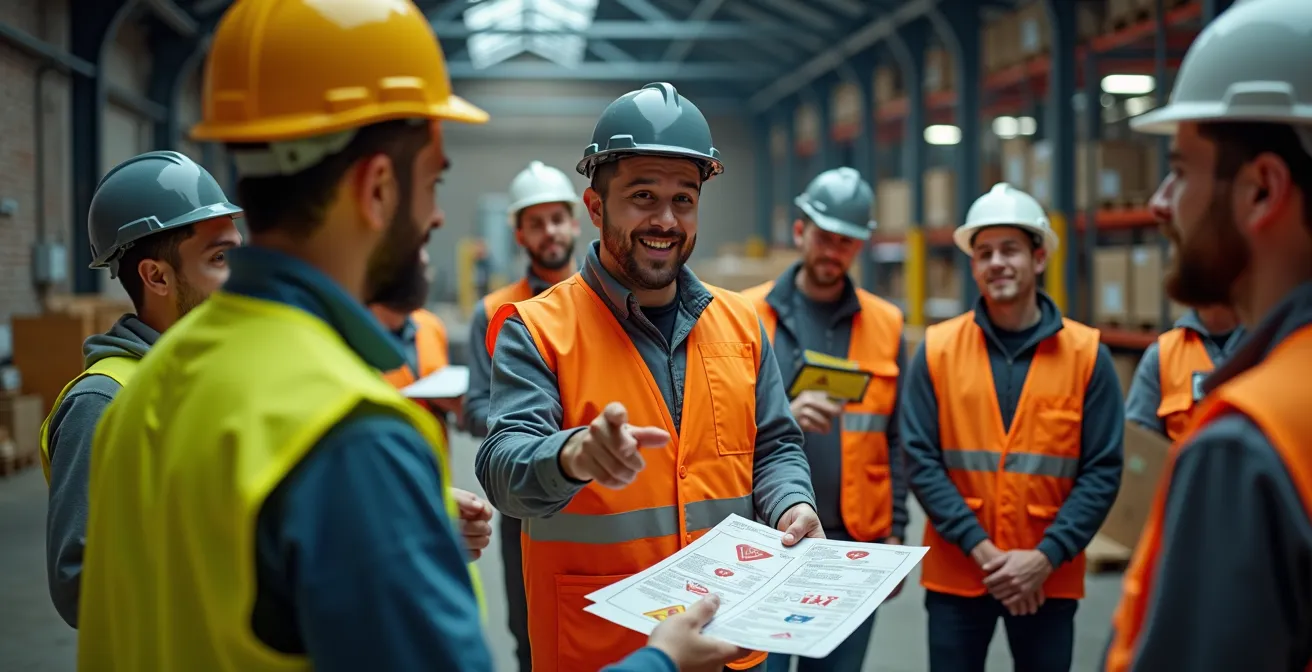
You are there, standing before your team. The faces are familiar, the looks a bit weary. It’s time for the annual WHMIS training, and you already feel that wave of resignation. The same pictograms, the same Safety Data Sheets (SDS), the same PowerPoint as last year. You know they know the theory, but between knowledge and daily application, there is a gap. Legal compliance is one thing, but real safety—the kind that becomes a reflex—is another.
Classic approaches, like showing a video or asking a few questions at the end, have reached their limits. They tick an administrative box but often fail to make an impression on a manual workforce accustomed to action. What if the key wasn’t to teach more, but to practice differently? What if the true mission was no longer to make them memorize rules, but to forge collective habits and shared vigilance?
This article is for you, the internal trainer in Montreal, looking to dust off this legal obligation. We aren’t just going to list tips, but explore pedagogical strategies rooted in the reality of adults in the Quebec industrial sector. The goal: transform this dreaded session into an engaging moment that builds true practical safety intelligence. From playful competition to managing the new linguistic requirements of Bill 96, discover how to make your next WHMIS training the most memorable one yet.
To guide you, we have structured this article around eight strategic questions that every trainer asks. Each section provides a concrete answer directly applicable to your Montreal context.
Table of Contents: Making WHMIS Training Vibrant and Relevant in Montreal
- Why transforming the safety quiz into a team competition improves retention?
- How to train allophone workers on chemical risks without an interpreter?
- Paper quiz or field observation: which method truly validates learning?
- The risk of giving 4 hours of straight theoretical training to manual workers
- When to renew forklift and first-aider cards: managing the calendar flawlessly
- How to measure the real productivity gain after costly technical training?
- How to manage the new Bill 96 francization requirements for your workers?
- How to establish a positive safety culture where employees look out for one another?
Why transforming the safety quiz into a team competition improves retention?
Fatigue with the end-of-training quiz is a classic issue. For a manual worker, pure memorization of symbols is often perceived as an abstract exercise disconnected from the reality of the workshop. Team competition, on the other hand, taps into much more powerful psychological levers: team spirit, motivation through play, and collective responsibility. Rather than answering alone on a sheet of paper, the worker must collaborate, argue, and defend a point of view with their colleagues.
This approach transforms a stressful individual assessment into a stimulating collective ritual. Information is no longer simply “learned”; it is debated, validated by the group, and applied to concrete scenarios. Retention is improved because the brain now associates the information with a positive emotion (the game, the victory) and social interaction. They no longer just remember the “flammable” pictogram; they remember the time their team won points by identifying the correct fire extinguisher faster than the others.
Micro-learning, or learning in small doses, can perfectly complement this approach. The Association paritaire pour la santé et la sécurité du travail du secteur minier (APSM) in Quebec, for example, views online training not as a replacement, but as a complementary method to diversify teaching modes. This diversification is key to maintaining attention.
Your action plan: dynamize training through play
- Create departmental teams with a quarterly points system and a “Safety Cup Standings.”
- Organize an “SDS Treasure Hunt” where teams locate and interpret sheets in the warehouse under a timer.
- Structure the quiz around solving concrete scenarios rather than pure pictogram memorization.
- Identify “safety champions” during competitions to serve as informal training relays.
- Implement non-monetary rewards: a paid breakfast, a mention in the internal newsletter, or public recognition.
How to train allophone workers on chemical risks without an interpreter?
The language barrier is a major challenge for safety in Montreal’s cosmopolitan industrial environment. Waiting for an interpreter is not always possible or efficient. The key is to rely on the universal language of safety: visuals and gestures. WHMIS pictograms are designed to be understood beyond words, but their interpretation must be reinforced by non-verbal methods.
Rather than a long speech, prioritize physical demonstrations. Show how to handle a container, how to put on personal protective equipment (PPE), and associate each action with a specific pictogram. Using color codes and standard, simple gestures for “danger,” “stop,” “caution,” or “protection required” creates reflexes that transcend languages. This is practical intelligence in action.
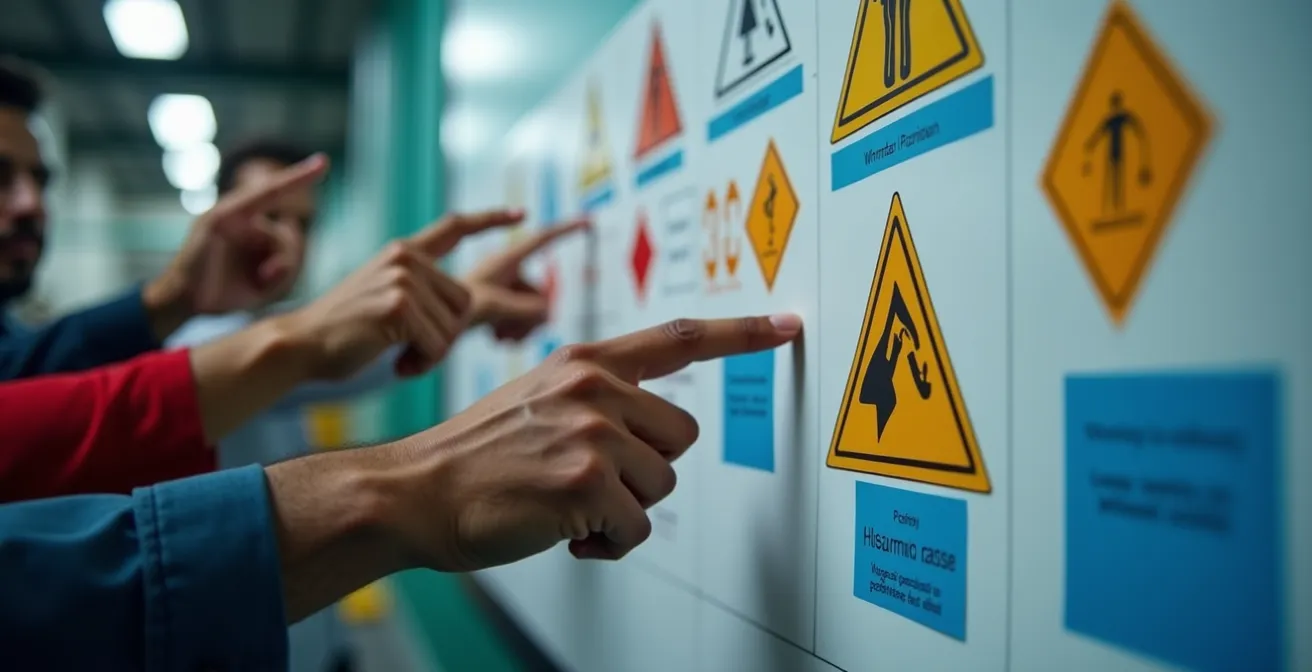
As this approach shows, direct interaction with symbols and gestures anchors learning in the body, not just the mind. Another powerful strategy widely used in Quebec is the buddy system. By pairing a new allophone arrival with an experienced French-speaking worker, you create a direct and contextual transmission channel. The mentor can, after official training, demonstrate concretely at the workstation: “Careful, this product, the one with this symbol, we handle it *like this*.” This is a direct application of the requirements of the CNESST, which regulates additional requirements for specific sectors in Quebec.
Paper quiz or field observation: which method truly validates learning?
A score of 100% on a paper quiz proves only one thing: the ability to memorize information at a specific moment. It does not guarantee that the worker will react correctly to a chemical spill or consistently wear their gloves. True skill validation is not found in theoretical “knowledge,” but in practical “know-how.” This is where field observation becomes not only useful, but indispensable to prove the employer’s due diligence.
Structured observation, using an evaluation grid, allows for the measurement of actual behaviors and reflexes. Does the worker check the label before use? Do they know where the eyewash station is? Do they follow proper storage procedures? These actions are the concrete translation of WHMIS knowledge. Documenting these observations (with dated photos or videos if possible) constitutes a much more solid competency file than a pile of questionnaires.
The following table, inspired by industrial best practices, summarizes the strengths and weaknesses of each evaluation method. As shown by data available from organizations like ASP Construction, which offers WHMIS training, the trend is toward complementary approaches.
| Method | Objective | Advantages | Limitations |
|---|---|---|---|
| Paper quiz | Validate theoretical knowledge | Fast, standardized, basic legal obligation | Does not prove practical competence |
| Field observation | Prove competence and due diligence | Evaluates actual actions, objective measurement with grid | More time-consuming, requires trained observers |
| Emergency simulation | Test real-time reaction | Ultimate test of retention, realistic scenario | Requires more resources and preparation |
For effective field observation, focus on critical skills. Here are the essential points to check:
- Does the worker systematically check the label before using a hazardous product?
- Are they wearing the appropriate personal protective equipment (PPE) according to the SDS?
- Do they know how to locate and use the eyewash station and emergency equipment?
- Are they able to interpret danger pictograms and apply precautionary statements?
- Is the observation process documented to create a competency file?
The risk of giving 4 hours of straight theoretical training to manual workers
Inflicting four hours of classroom theory on an audience whose job is based on physical action is a recipe for pedagogical failure. This ignores a fundamental principle of andragogy (adult education): attention span is not infinite. Indeed, studies show that an adult’s attention span drops significantly after 90 minutes, and this number is even lower for an audience used to moving around.
Beyond 90 minutes, the brain checks out. Information is no longer absorbed; it is endured. The risk is twofold: not only does the training become ineffective and a waste of time, but it also generates frustration and a negative perception of safety in general. The solution is not to reduce the content, but to deliver it in pedagogical micro-doses, a much more digestible and effective approach.

Sequenced micro-learning involves breaking a monolithic training block into several short, targeted sessions spread over time. This method respects the biological and cognitive rhythm of learners, anchors knowledge over the long term, and allows for a dynamic rotation of theory and practice. Here is how to structure such an approach:
- Divide the 4-hour training into four 1-hour sessions, spread over four days or a week.
- Structure each session: 20 minutes of theory, 20 minutes of workshop practice, 20 minutes of review or team quiz.
- Schedule sessions just before breaks to encourage informal discussion and consolidation of learning.
- Vary the media: a short video, a hands-on exercise, a group discussion.
- Integrate active 2-3 minute breaks every 30 minutes to reset attention.
When to renew forklift and first-aider cards: managing the calendar flawlessly
Certification management is a pillar of occupational health and safety compliance in Quebec. Forgetting a renewal date can have serious consequences, both legally and for operational safety. For an internal trainer, setting up a rigorous tracking system is not an option; it is a necessity. The two most common certifications with a fixed deadline are forklift operator and workplace first-aider.
For these two skills, the rule is simple: requalification is essential. Although the law does not impose a strict expiration date for forklift training, the CSA B335-15 standard, which is authoritative, and the CNESST strongly recommend requalification every 3 years. Similarly, first aid certifications are generally valid for 3 years. For WHMIS, the situation is different: there is no fixed deadline. Training must be updated as soon as a new hazardous product is introduced or working conditions change.
However, as a best practice and to maintain constant vigilance, many Quebec companies opt for an annual refresher. The following table summarizes the management schedule for the main certifications.
| Certification | Validity | Legal Requirement | Recommendation |
|---|---|---|---|
| WHMIS | No fixed deadline | Update based on changes | Annually |
| Forklift | 3 years | CSA B335-15 | Refresher every 3 years |
| First-aider | 3 years | Mandatory CNESST | Full 16h training |
| Lockout/Tagout | Variable | Internal policy | Every 2-3 years |
The best strategy is to use human resources management software or a simple shared spreadsheet to track expiry dates for each employee. Set up automatic alerts 90 days before expiration to allow time to plan requalification sessions without disrupting production.
How to measure the real productivity gain after costly technical training?
Justifying the investment in training like WHMIS goes beyond simple compliance. Management wants to see a return on investment (ROI), but this is not always measured in direct dollars. The productivity gain is often indirect but very real. It manifests through the reduction of incidents and time lost due to insecurity or lack of information.
Effective and well-assimilated WHMIS training results in more confident and autonomous workers. They waste less time looking for an SDS, hesitating over which PPE to use, or asking for help interpreting a label. Every minute saved, multiplied by the number of employees and working days, represents a substantial productivity gain. Furthermore, a safer work environment reduces near-misses, work stoppages, and production interruptions. Indeed, companies that have invested in interactive training have contributed to a drop of more than 6% in occupational injuries in Quebec in 2024, a direct indicator of human and financial ROI.
To quantify these gains, key performance indicators (KPIs) must be established before and after training. Here are some concrete examples to track:
- Average time to find an SDS: Time this task before and after training to measure the improvement in information access.
- Number of reported near-misses: Monthly track the number of avoided incidents related to chemicals. A decrease is a sign of better prevention.
- Error rate in storage: Analyze internal inspection reports to count errors in labeling or storage of hazardous products.
- Calculated time saved: Estimate the gain by calculating: (minutes saved per day) x (number of employees) x (working days).
- CNESST inspection reports: A decrease in WHMIS-related non-compliance during official visits is the ultimate proof of the training’s success.
How to manage the new Bill 96 francization requirements for your workers?
Bill 96, which strengthens the Charter of the French Language in Quebec, has direct implications for health and safety training. It stipulates that communications to workers, including training, must be in French. For a trainer, this should not be seen merely as an administrative constraint, but as an opportunity to clarify and standardize safety vocabulary for everyone.
The stakes are vital. A misunderstanding of a technical safety term in French can lead to a serious accident. Francization, in this context, is synonymous with universal understanding within the company. As highlighted by a guide from the CNESST, the reference authority on the matter:
Mastery of safety vocabulary in French is not only a legal obligation, but a vital necessity for worker protection.
– CNESST, Guide de francisation en milieu de travail
To respond to this requirement proactively and effectively, francization must be integrated into the heart of the WHMIS training strategy. It is not about translating documents at the last minute, but about building a work environment where French is the clear and unambiguous vehicle for safety. Here is a concrete action plan:
- Create a survival glossary of 20 critical WHMIS terms in French, illustrated with pictograms, and post it near workstations.
- Add simple phonetic translations for complex terms to help with pronunciation.
- Include clauses regarding the quality of linguistic training in contracts with external training providers.
- Document every francization action (posters, training, glossaries) to demonstrate your proactive approach to the Office québécois de la langue française (OQLF).
- Position WHMIS training as the starting point and pilot project for your company’s global francization plan.
Key Takeaways
- Team competition transforms a passive obligation into a stimulating challenge, radically improving engagement and retention.
- Skill validation must take place in the field by observing real actions, as a theoretical quiz does not prove the acquisition of a safety reflex.
- “Marathon” training sessions are counterproductive; short, frequent sessions (micro-learning) respect attention spans and anchor knowledge better.
How to establish a positive safety culture where employees look out for one another?
The most perfect training will never replace human vigilance. The ultimate stage of a mature safety culture is reached when employees no longer rely solely on the supervisor but look out for each other. This is the concept of shared vigilance—a system where reporting an oversight or a risk is not an act of informing, but an act of kindness and collective protection.
Establishing such a culture is a challenge, especially in environments where criticism can be poorly received. Initiatives like the “I’ve Got Your Back” program, implemented in the construction sector by unions like FTQ-Construction (which represents 44.1% of workers in the sector), show the way. These programs reframe intervention: correcting a colleague who forgets their safety glasses isn’t reprimanding them; it’s taking care of them. This requires a strong commitment from management to promote this message and value those who dare to intervene positively.
The stakes are high. Despite efforts, the CNESST recorded 246 work-related deaths in 2024 in Quebec. Every incident avoided thanks to a colleague’s intervention is a victory. For this to work, the act of correction must be depersonalized. Feedback should focus on behavior, not the person, and be phrased constructively (“Hey, don’t forget your gloves for this product” rather than “You didn’t put on your gloves!”). As a trainer, your role is to sow the seeds of this culture during every session, presenting safety not as a list of individual rules, but as a social contract that binds all team members.
To permanently transform safety in your company, the next step is to apply these principles by creating a training plan adapted to your reality. Evaluate the strategies presented here now and identify those that will have the most impact on your teams.