Every bin of residues leaving your Montreal factory is not just a cost; it is dormant revenue and a regulatory risk that could be transformed into a competitive advantage.
- The valorization of your residues through industrial symbiosis generates new revenue streams while drastically reducing landfill fees.
- The Synergie Montréal platform is the central tool for identifying local partners, but success relies on optimized logistics and perfect regulatory compliance with the MELCCFP.
Recommendation: Start today with a precise diagnosis of your material flows (volume, composition, frequency) to identify the most profitable and secure valorization opportunities.
As an environmental manager in Greater Montreal, the “zero waste to landfill” goal can sometimes feel like an unreachable summit. Disposal costs continue to rise, and regulatory pressure is intensifying. You have likely already implemented recycling and source reduction programs—the pillars of any sound environmental management. However, these efforts often hit a plateau, leaving volumes of production residues—scraps, rejects, co-products—that inevitably end up in a landfill.
What if the real key wasn’t seeing these flows as waste to be eliminated, but as dormant revenue and regulatory risks to be managed? Industrial symbiosis, far more than an ecological ideal, is a lever for economic performance and legal compliance. It is not simply about “recycling more,” but about strategically reintegrating your residues into the local economy as valuable raw materials for other companies, often located just a few kilometers from your plant.
This article is not a theoretical dissertation on the circular economy. As an advisor connected to the Synergie Québec network, my goal is to provide you with a pragmatic action plan. We will break down how to evaluate the financial value of your residues, use the tools at your disposal to find takers, decide between different valorization streams, and, above all, secure the entire process from a regulatory standpoint. Let’s transform this constraint into a tangible opportunity for your company.
To navigate these strategic steps effectively, this guide is structured to accompany you step-by-step. You will discover how to turn a cost center into a profit center while strengthening the resilience and image of your company within the Montreal territory.
Summary: From Residue Management to Revenue Creation Through Industrial Symbiosis in Montreal
- Why your production scraps are worth more than you think?
- How to use the Synergie Montréal platform to find a buyer for your residues?
- Material recycling or direct reuse: which stream is the least costly logistically?
- The risk of transporting “waste” without Ministry of Environment permits
- Where to place sorting bins in the factory to maximize material purity?
- Virgin plastic or Post-Consumer Recycled (PCR) plastic: the true cost of transition
- Rail transport or trucking for regional delivery: the cost/speed duel
- How to integrate eco-design to reduce your material and packaging costs?
Why your production scraps are worth more than you think?
The most common perception is to view industrial residues as an inevitable burden. Every ton sent to a landfill represents a direct cost that impacts your profitability. In Quebec, this expense is far from negligible. According to the latest government royalties, the cost stands at $32 per metric ton in 2024, to which processing fees ranging from $120 to $175 are added. For a company generating 10 tons of waste per month, this represents an annual cash outflow of over $20,000, with zero return on investment.
However, this calculation does not take into account the opportunity cost, or what we call dormant revenue. Your plastic scraps, metal chutes, wood residues, or even production sludge can be a valuable raw material for another company. Industrial symbiosis consists precisely of activating this dormant revenue by creating a commercial transaction where there was only an elimination cost.
The example of Papier Emballage Arteau, an SME in Montreal North, is particularly telling. By joining the Synergie Montréal network, the company began valorizing residues from Graphic M&M (fabric printing) and Vetshell (precision parts manufacturing). What was waste for some became a resource for the other, creating new revenue and an entirely new customer network. This approach transforms an environmental obligation into a true competitive advantage and demonstrates that your “waste” has a concrete market value just waiting to be exploited.
Evaluating this value is the first step. It depends not only on the nature of the material but also on its quality, quantity, and the consistency of its flow. A precise characterization of your residues is therefore the starting point for transforming a cost into a profit.
How to use the Synergie Montréal platform to find a buyer for your residues?
Once the potential value of your residues is identified, the crucial question is: how do you find the right industrial partner? This is where Synergie Montréal, the local branch of the provincial Synergie Québec network, becomes your most strategic ally. It is not just a directory, but an active matchmaking ecosystem designed to catalyze circular economy opportunities within the territory.
The platform operates on a simple principle: companies publish “offers” (the residues they generate) and “demands” (the materials they need). The Synergie Montréal team, composed of expert territorial animators, then facilitates the linkage between companies whose needs and resources are complementary. Their role is to actively support you, from material characterization to the conclusion of a commercial agreement.
The effectiveness of this model is well-proven. Since its inception, the network has enabled the implementation of over 850 concrete synergies between 2020 and 2022. For the Montreal region alone, the impact is significant: more than 4,500 tons of materials have been diverted from landfills since 2016, generating nearly 11 million dollars in economic benefits for participating companies. These figures demonstrate that the platform is a powerful engine for value creation.
For an environmental manager, using Synergie Montréal offers double security. On one hand, it gives you access to a qualified network of over 3,300 Quebec companies, drastically increasing your chances of finding a reliable local buyer. On the other hand, the guidance from animators ensures that the proposed synergies are viable both logistically and regulatorily. This represents a considerable time gain and risk reduction compared to searching for partners alone.
Material recycling or direct reuse: which stream is the least costly logistically?
Finding a partner is one thing, but ensuring the profitability of the transaction is another. The choice of the valorization stream—primarily between recycling via a sorting center and direct reuse by another company—is a crucial cost-stream trade-off. The decision must not rest solely on the ecological aspect but on a pragmatic analysis of logistical costs, quality requirements, and operational risks.
Direct reuse is often the ideal of the circular economy: your scraps directly become the raw material for a neighboring factory. Logistically, this is the shortest and least expensive route. Transport is limited to a journey of a few kilometers within the same industrial park. However, this stream is also the most demanding. It requires impeccable and consistent material quality, as the partner integrates it directly into their manufacturing process. Any contamination or variation can lead to a batch rejection, which would destroy the operation’s profitability.
Conversely, recycling via a sorting center offers more flexibility. Sorting centers are designed to manage mixed material flows and have processes to separate components. Tolerance for quality variations is therefore higher. However, logistics are often more complex and costly. Sorting centers are generally located further away, increasing transport fees and the associated carbon footprint. Although the processing cost for recyclable materials is zero, the distance can make this option less financially attractive for large volumes.
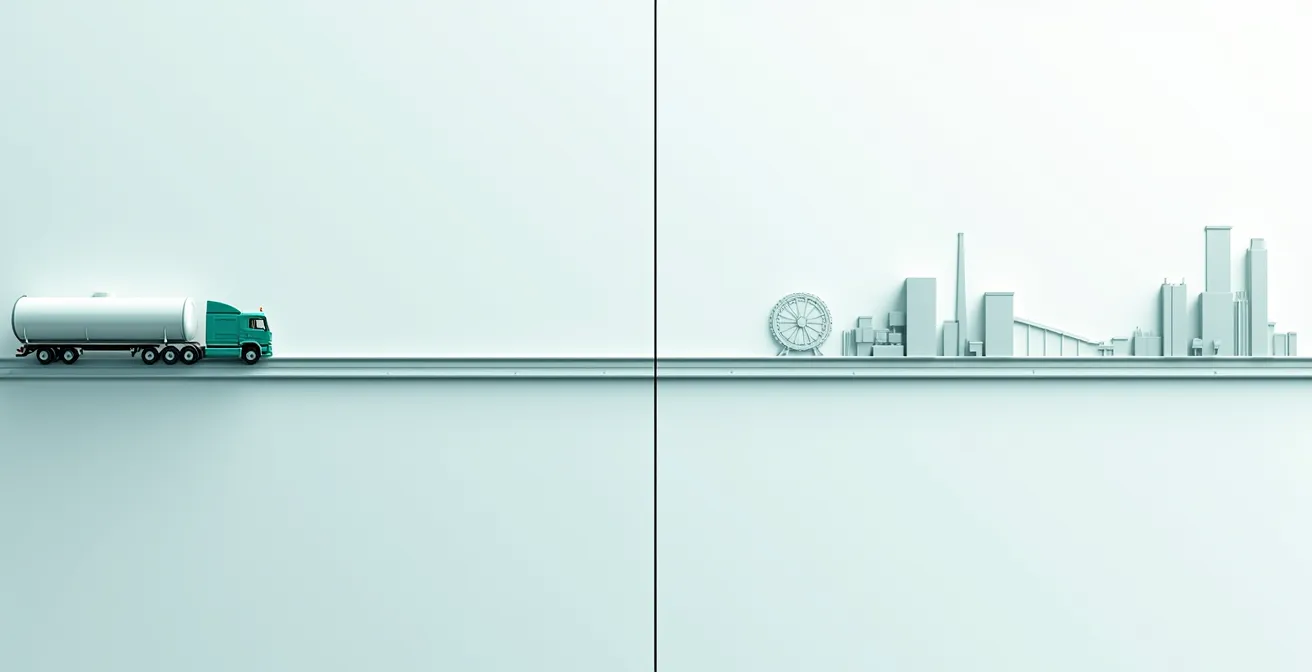
This diagram perfectly illustrates the dilemma: a short and direct but demanding route, versus a longer and indirect but more tolerant route. The following table summarizes the key points of this trade-off for a company located in Montreal.
| Criterion | Recycling (sorting center) | Local direct reuse |
|---|---|---|
| Processing cost | $0/ton (recyclable materials) | $0 (direct exchange) |
| Transport (10 tons/month) | Higher average distance to sorting centers | Direct delivery within the industrial park |
| Required quality | Higher tolerance for variations | Consistent quality mandatory |
| Risk of rejection | Low (standardized process) | High if quality is not guaranteed |
The risk of transporting “waste” without Ministry of Environment permits
Transforming your residues into revenue is a powerful strategy, but it enters you into a strictly regulated field: residual materials management in Quebec. The greatest risk for an environmental manager is not failing to find a taker, but conducting a transaction outside the legal framework. Transporting a material, even a valuable one, without the proper documentation can cause it to be reclassified as “waste” and expose your company to significant financial sanctions.
The Ministry of the Environment, the Fight Against Climate Change, Wildlife and Parks (MELCCFP) is the regulatory authority. The key is to distinguish between a “valuable residue” and a “residual material.” If your material is poorly characterized or transported in a non-compliant manner, you could be subject to elimination royalties. According to the Quebec government’s Regulation respecting charges payable, this royalty amounted to $30 per metric ton in 2023, with annual indexation.
So, how do you secure your transactions? The first step is to obtain a valorization certificate (attestation de valorisation) from the MELCCFP. This official document certifies that your residue will indeed be used as a raw material by another company and is not intended for disposal. To obtain it, you must provide a complete characterization of the residue and proof of its future use by the valorizer. It is an administrative process that may seem heavy, but it is your best insurance against regulatory risk.
Failing to take this step seriously can turn a circular economy initiative into a non-compliance nightmare. Mandating an environmental regulatory consultant or relying on the expertise of Synergie Québec animators becomes profitable as soon as your volumes are significant or the nature of your residues is complex. Ignoring this aspect is playing with fire.
Where to place sorting bins in the factory to maximize material purity?
The market value of your residues, and therefore the success of your industrial symbiosis approach, depends directly on one factor: material purity. A batch of plastic contaminated with cardboard or organic residues will be immediately devalued, or even rejected by a partner. The battle for quality is won at the source, directly on the factory floor, through strategic sorting organization.
A common mistake is placing sorting bins in centralized collection areas, far from workstations. This approach forces employees to make extra trips and increases the risk of errors due to lack of time or convenience. An effective organization, inspired by the Kaizen approach to continuous improvement, integrates sorting directly into the production flow. Bins must be natural waypoints, not detours.
The use of a clear and standardized color code is also fundamental. In Quebec, the norm recommended by RECYC-QUÉBEC is simple and effective: blue for recyclable materials (plastic, glass, metal, paper), brown for organic materials, and black for ultimate waste. This visual code must be reinforced by simple displays using pictograms rather than complex text. Studies show that this visual signaling can reduce human error by nearly 40%.
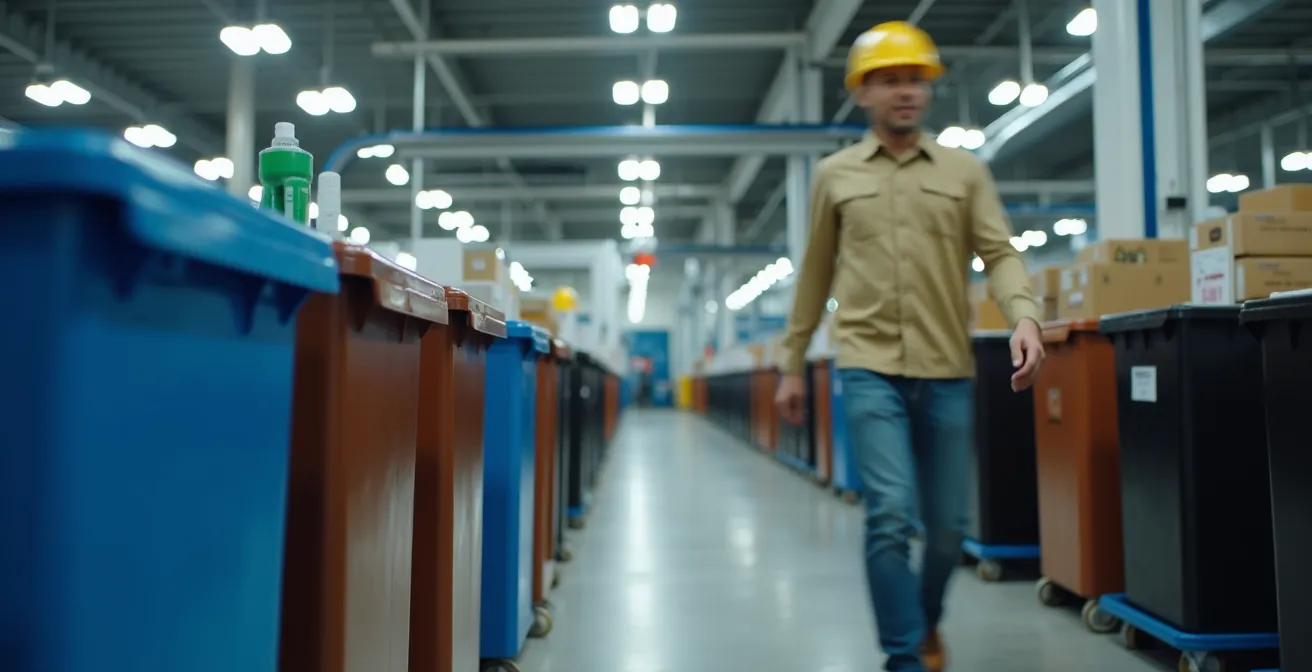
Optimization doesn’t stop at placement. Container size, internal collection frequency, and continuous team training are equally important for maintaining a high level of purity. To help you set up a robust system, here is an action plan directly inspired by best practices.
Your action plan for impeccable factory sorting
- Integration at the workstation: Place small bins directly at the points of residue generation so that sorting becomes a reflex integrated into the process.
- Visual standardization: Deploy a strict color code (blue, brown, black) on all containers and reinforce it with clear, jargon-free visual posters.
- Creation of waypoints: Position larger collection bins on employees’ natural paths (toward the exit, cafeteria, etc.) to facilitate the emptying of individual containers.
- Audit and feedback: Regularly inspect bin contents to identify recurring sorting errors and hold short feedback sessions with the concerned teams.
- Collection optimization: Adapt internal pickup frequency to the actual volume of each material to avoid overflows that lead to cross-contamination.
Virgin plastic or Post-Consumer Recycled (PCR) plastic: the true cost of transition
For companies using plastic in their products or packaging, the debate between virgin resin and Post-Consumer Recycled (PCR) plastic is often perceived as a simple ecological choice. However, in the current Quebec context, it is an increasingly strategic economic decision. The transition to PCR is no longer an option, but a competitive prerequisite.
Historically, virgin plastic was often cheaper and more consistent in quality, which slowed PCR adoption. But the landscape has radically changed. On one hand, tens of millions of dollars have been invested by Éco Entreprises Québec to modernize sorting centers, thereby considerably improving the quality and availability of Quebec-made PCR. Local recycled material is now a reliable resource.
On the other hand, and this is the most powerful lever, the implementation of Extended Producer Responsibility (EPR) in 2025 has flipped the economic equation. Under EPR, companies putting packaging on the market must now fund its entire life cycle, from collection to recycling. The system is modulated: the harder a package is to recycle (complex plastics, multi-layers), the higher the company’s financial contribution. Using packaging made from non-recyclable virgin plastic thus becomes a direct financial disadvantage.
In this context, integrating PCR into products or opting for 100% recyclable packaging is no longer a “cost” of transition, but an investment to reduce future financial obligations. Although this transition may require technical adjustments to production equipment to adapt to PCR properties, it is becoming an imperative for managing long-term costs and meeting the requirements of major buyers, who increasingly integrate recycled content into their procurement criteria.
Transport ferroviaire ou camionnage pour la livraison régionale : le duel coût/vitesse
The profitability of an industrial symbiosis is determined not only by the value of the material but also by the efficiency of its logistics. While the ideal partnership is found within the same industrial park, many valorization opportunities exist at the regional scale, between Montreal and Montérégie, Lanaudière, or the Laurentians. The choice of transport mode between trucking and rail then becomes a decisive factor.
Trucking is the champion of flexibility and speed for short and medium distances. It offers door-to-door service, easily adapts to volume variations, and allows for rapid deliveries. For synergies within a 100 to 200 km radius, it remains the simplest and most reactive solution. However, its cost per ton-kilometer is higher, it is subject to road traffic hazards, and its carbon footprint is larger.
Rail transport, meanwhile, is the master of large volumes over long distances. Its cost per ton-kilometer is significantly lower, making it highly competitive for regular and large material flows. In Canada, the market is dominated by two giants, with CN representing over 50% and CP around 35% of industry revenue, offering a dense network. The main drawback of rail is its lower flexibility. It requires pre- and post-carriage operations by truck (the “first and last mile”) and generally longer delivery times.
The trade-off therefore depends entirely on the nature of your symbiosis. For a one-off or low-volume flow to a partner in Laval, trucking is unbeatable. For a long-term contract involving sending several railcars of residues per month to a plant in Trois-Rivières or the Eastern Townships, rail can offer substantial economies of scale that justify the extra logistical complexity. The analysis must integrate not only transport costs but also handling and storage costs at both ends of the chain.
Key Takeaways
- Your industrial residues are not waste, but “dormant revenue” whose value is revealed by avoided landfill costs and new sales.
- The Synergie Montréal platform, supported by expert animators, is the most effective tool for finding reliable local partners.
- Material purity, ensured by rigorous sorting at the source, is the sine qua non for maximizing the value of your residues and the success of any symbiosis.
How to integrate eco-design to reduce your material and packaging costs?
We have explored how to valorize existing residues, but the most powerful approach in the circular economy is thinking about valorization before the residue is even created. This is the role of eco-design. Rather than suffering the characteristics of your rejects, it is about designing your products and processes so that the generated co-products are directly and easily usable by others.
This proactive approach fundamentally transforms industrial symbiosis. Instead of searching after the fact for a taker for a complex material, you can establish pre-arranged partnerships by designing a product whose scraps perfectly match the needs of a neighboring company. A UQAM study on industrial symbiosis in Montreal North highlighted this potential by analyzing eight companies in the territory. It demonstrates that integrating eco-design upstream allows for the creation of local, near-automatic, and highly profitable valorization loops.
Eco-design applies not only to the product itself but also to its packaging. In connection with new EPR regulations, choosing mono-material packaging that is easily recyclable and contains a percentage of PCR is no longer just an ecological gesture; it is a direct cost reduction strategy. Designing packaging that minimizes losses during unpacking at your industrial customer’s site can also create a new flow of valuable material.

Integrating eco-design means moving from a reactive logic (“what do I do with my waste?”) to a predictive logic (“how do I design to no longer have waste?”). This is the ultimate stage of maturity in the circular economy, where environmental management is no longer limited to one department but infuses strategy, R&D, and production. It is by closing the loop at the drawing board that you will achieve the most significant and sustainable gains.
To initiate this transformation, the next step consists of performing a complete diagnosis of your residual materials. Contact your local Synergie animator to schedule this first analysis and begin unlocking your dormant revenue.
Frequently Asked Questions on Industrial Symbiosis and Waste Management
What is the difference between a ‘valuable residue’ and ‘hazardous residual material’ according to the MELCCFP?
A valuable residue can be reused in an industrial process without major treatment, while a hazardous residual material requires special authorizations and specific treatment according to Quebec’s Regulation respecting the framework for authorization of activities (REAFIE) based on their impact on the environment.
How do I obtain a valorization certificate to secure transport?
You must submit a request to the MELCCFP with the complete characterization of the residue and proof of its future use by the valorizer. This document is crucial for proving the material is not destined for disposal.
When is it profitable to hire an environmental regulatory consultant?
As soon as you manage more than 100 tons of residues per year or if your materials are legally complex to qualify, a consultant’s expertise can save you time and protect you against costly non-compliance risks.